 |
|||||||||||||||
|
|||||||||||||||
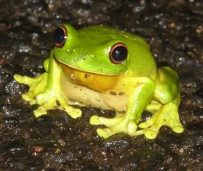
'Amphibians' are vertebrate animals that breathe through gills as juveniles (tadpoles) and through lungs as adults. .
All native amphibians in Australia are frogs - we have no native toads, newts, salamanders and caecilians (although some of our 'bumpier' frogs are referred to as 'toads' or 'toadlets' and the cane toad has been introduced from South America)
There are four frog families in Australia:
- two
large
families (treefrogs and 'southern' frogs) found
throughout Australia: their ancestors
appear to have been with us when we were part
of the southern
supercontinent of Gondwana. Most Australian
frogs belong to one of
these families.
- two
families (narrow-mouthed and 'typical' frogs)
found only in far
northern regions: their ancestors probably
joined us when Australia
drifted close to Asia. We have just a few
species
Remember this diagram to recall the two large families and the two much smaller (in Australia at least), northern families:
| Narrow-mouthed frogs | 'Typical'
frogs |
Treefrogs |
'Southern' frogs |
Click on the above families for a brief description of each. For further information try our links for frogs
Hylidae - treefrogs and their relatives
Found throughout Australia - many species
Their life history is pretty conventional - they lay eggs in the water, these hatch into tadpoles and later metamorphose (change their form) into adult frogs. Compare this with the 'southern frogs' and narrow-mouthed frogs below.
Most species belong to the genus Litoria, which includes the true treefrogs and others that don't often climb trees.
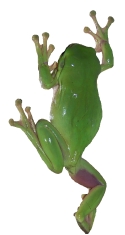
Many have extended toe-pads and finger-pads to assist them in climbing (see picture of the green tree frog to the right , also the orange-eyed treefrog pictured at the top right of this page)
 One of the
most
commonly-seen treefrogs is the little sedge-frog (see
picture to the
left), which often sits on
reeds or low shrubs, even during the day, and can be
brown or green, or
a mixture of both.
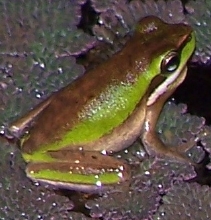
One of the
most
commonly-seen treefrogs is the little sedge-frog (see
picture to the
left), which often sits on
reeds or low shrubs, even during the day, and can be
brown or green, or
a mixture of both. Another is the much larger green tree frog, sometimes encountered in gutters, drainpipes, laundries and toilets, and often heard calling on warm wet evenings.
Emerald-spotted treefrogs have a distinctive 'machine-gun call'
Most frogs are pretty quiet during the cooler months, but the whistling treefrog can often be heard calling throughout winter.
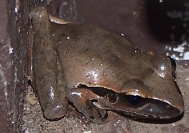
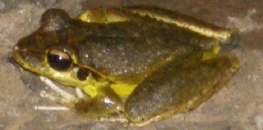
Rocket frogs belong to Litoria but spend most of their time on the ground. They not only have pointed, rocket-shaped noses (see the broad-palmed rocket frog to the left), but launch themselves vigorously into the air when disturbed.
Another species that doesn't seem to climb much is the stony creek frog (pictured to right). The male's sides turn bright yellow in breeding season
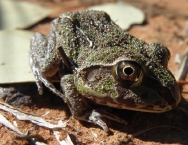 Several
other species
in
this family belong to the genus Cyclorana,
like this water-holding frog C.
platycephala
Several
other species
in
this family belong to the genus Cyclorana,
like this water-holding frog C.
platycephala(pictured to left) we found in the southern Queensland outback in early 2010.
Myobatrachidae - the 'southern frogs'
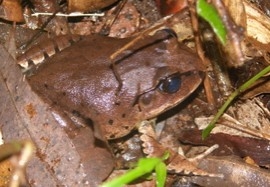
There are many species in this family throughout Australia
Pictured to the left is the great barred frog, which gives a deep "Walk, walk-walk" call, mostly at night but sometimes in daylight hours.
Microhylidae - narrow-mouthed frogs,
This is a family of small frogs found across most of the world's tropical regions.
The Australian species lay eggs that hatch not into tadpoles but into ready-formed frogs
Ranidae - the 'typical' frogs
Thus family is found throughout most of the world, but only one species in Australia
The ancestors of the narrow-mouthed and 'typical' frogs presumably joined us relatively recently from south-east Asia, which at least partly explains their fart northern distribution, whereas the other two families have been with us since we were part of Gondwana, and have had time to spread throughout the continent
An introduced toad
We unfortunately also have an introduced species of Bufonidae - the cane toad - which has been poisoning native mammals, reptiles and birds that eat it, and has been multiplying into large numbers and spreading across vast areas of eastern Australia since its release in the north Queensland cane fields.
Further information
- Frogs Australia A very comprehensive site
- Amphibian Declines in Australia
- Australia's oldest amphibians
- Field Guide to the Frogs of Australia (book)
- Tadpoles of Southeast Australia (book)
- See also Wildlife of the Scenic Rim