
|
|
|
|
Wildlife
Conservation
We share
our country with a wonderful array of other
species.Let's hope we continue to enjoy this
diversity well into the future.
Many
species are far less common than they
once were, and some are declining alarmingly.
Conservation
groups throughout Australia are
attempting to tackle some of the many
issues
Conservation
problems facing Australian wildlife include:
- habitat loss -
causing loss of species unable to live in
any other kind of habitat (the single biggest threat to
wildlife both locally and globally)
- habitat
fragmentation - a fair bit of habitat
remaining, but fragmented, making it
difficult for animals to move
from one patch to another, and creating edge
problems (e.g. some forest edges are
occupied by aggressive species such as noisy
miners, making it difficult for some of the
true forest species)
- habitat
alteration - loss of understorey shrubs,
logs, food plants, old trees with hollows
etc.
- feral animals -
competitors, predators and - in the case of
the cane toad - poisoners
- barriers to
movement - see 'Animals
Have to Move' on the Scenic Rim
Wildlife pages
- hunting (not as
great a problem here as in some countries,
but there is some illegal hunting and also a
black market trade) - see articles on wildlife
trade, shooting
in national parks
- road-kill - not
a global threat to most species, but could
cause local extinction in some regions, and
is a constant welfare problem
- disruptive
human activities - for instance
unsustainable tourism and recreational
activities, as well as industrial practices
in important areas of habitat, including
anything noisy near nesting, feeding or
resting sites. See
Wildlife Tourism Australia and our ecotourism
and tourism
and conservation pages for some
discussions on responsible wildlife tourism
- plastics and
other pollution - seabirds, turtles, whales
and other marine creatures often swallow
large bits of plastic thinking they are
jellyfish or large quantities of
micro-plastics among the krill, often with
fatal results. See Dangers
of plastic to marine life
- climate
change - e.g. for a world view see the
WWF
climate change site or
this Australian
government
site,
and warnings on effects on Australian
wildlife by CANA's.
Also
daily monitoring by CSIRO
|
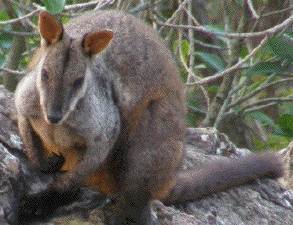
brush-tailed
rock-wallaby
(vulnerable, used to be common and far more
widespread, now confined to rocky uplands
due to habitat clearing and introduced
predators)
|
|
Local
conservation groups (Scenic Rim):
Elsewhere in
Queensland:
Elsewhere in
Australia:
|
|
Climate
Change
Some notes on
climate change
A new site by CSIRO
let's us see the daily
monitoring of greenhouse gases
This was my
concluding remark in a presentation by Ronda
Green at the Green
Travel, Climate Change and Ecotourism in 2008,
and following are references she used in preparing
the talk:
"When we were
children, we thought the North Pole would always
be covered in ice and the world would always have
wild polar bears. It is uncomfortable to realise
this is not necessarily so. It is frightening to
think of the other, very great changes that may be
happening within our lifetimes. But that is what
we must do – think about them, and the many
complexities involved, if we are to find any
solutions within the very little time we have
available."
References I found
useful in researching for this presentation:
- Beaumont, L.J., I.A.W. McAllan, and I. Hughes.
2006. A matter of timing: changes in the first
date of arrival and last date of departure of
Australian migratory birds. Global Change
Biology 12: 1339-135
- Burton, C. T. and Weather, W. W.2003.
Energetics and thermo-regulation of the Gouldian
Finch (Erythrura
gouldiae). Emu 103(1) 1 - 10
- Green K. and Pickering C. M. (2002) A scenario
for mammal and bird diversity in the Australian
Snowy Mountains in relation to climate change.
pp241-249 in: C. Koerner and E.M. Spehn (eds)
Mountain Biodiversity: a Global Assessment.
Parthenon Publishing, London
- Green, R.J. 1993 Avian seed dispersal in and
near subtropical rainforests. Wildlife Research
20: 535-557
- Hoegh-Guldberg, O. 1999. Climate change, coral
bleaching and the future of the world's coral
reefs. Marine and Freshwater Research 50: 839 –
86
- Hoegh-Guldberg, O. 2005. Low coral cover in a
high-CO2 world. Journal of Geophysical Research,
Volume 110
- Hughes L (2000) Biological consequences of
global warming: is the signal already apparent?
Trends in Ecology and Evolution, 15, 56–61
- Sands, D. 2008. Conserving the Richmond
Bird-wing Butterfly over two decades: Where to
next? Ecological Management & Restoration 9:
4 – 16
- Welbergen, J. A., Klose, S. M., Markus, N. and
Eby, P. 2007. Climate change and the effects of
temperature extremes on Australian flying-foxes.
Proceedings of the Royal Society of London
Series B:10.1098/rspb.2007.1385
- Williams S. E. , Bolitho E. E., and Fox S.
2003. Climate change in Australian tropical
rainforests: an impending environmental
catastrophe. Proceedings of the Royal Society of
London Series B-Biological Sciences 270 (1527):
1887-1892
- WWF Threatened species network. Australian
threatened species: green turtle Chelonia mydas.www.wwf.org.au/ts
|
|
Wildlife Preservation Society of
Queensland: main branch
From
the website of the Wildlife
Preservation Society of Queensland:
"The
Wildlife
Preservation
Society of Queensland is the oldest, largest and
most respected wildlife-focused conservation group
in Queensland.
We’ve
been part of all the major conservation issues in
Queensland for almost 50 years"
The
Society
was created as a community-based, non-profit
organisation, founded in 1962 by well-known
Australian poet Judith Wright, publisher Brian
Clouston, zoologist David Fleay and artist/author
Kathleen MacArthur.
Their news page keeps us up-to-date with much of
what is happening to wildlife
in Queensland and beyond
Wildlife Preservation Society of
Queensland: Scenic Rim group
 The Scenic Rim group of WPSQ is so
far an informal group, planning to become a
fully-fledged branch some time in 2010, covering the
species-rich region of Southeast Queensland starting
from abut 50km south of Brisbane, from (and
including) Lamington National Park and
Tamborine Mountain in the east to the Main Range in
the west, its southern boundary running along the
Queensland/NSW border. The Scenic Rim group of WPSQ is so
far an informal group, planning to become a
fully-fledged branch some time in 2010, covering the
species-rich region of Southeast Queensland starting
from abut 50km south of Brisbane, from (and
including) Lamington National Park and
Tamborine Mountain in the east to the Main Range in
the west, its southern boundary running along the
Queensland/NSW border.
A Wildlife Expo is to be held on Sunday 18th July,
in Beaudesert, south-east Queensland, in conjunction
with the Logan
and Albert Conservation Association
There are further links to other conservation
associations from the Scenic Rim group of WPSQ website
Also visit the Scenic
Rim
Wildlife's Facebook page
|