 |
|||||||
| Home |
Tours |
Wildlife | Our region | Prices | About Araucaria |
Contact us |
|
 About Araucaria Ecotours
Also see the Araucaria blog and visit us on Facebook
Our
name: Why "Araucaria" and "Ecotours" ?
"Araucaria"
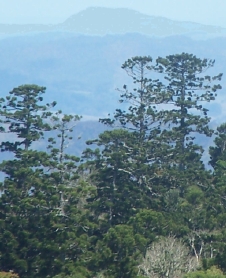
The other Australian species is the bunya pine (Araucaria bidwillii, important to the Aboriginals), and some of these have been planted on the Araucaria property. The Norfolk Island pine and the monkey puzzle tree of South America are also Araucaria species.
The Araucaria family - Araucariaceae - has a long history. It seems to have originated in Gondwana (the great southern supercontinent that included Australia, Antarctica, South America, Africa and India) before the days of the dinosaurs, and spread through much of the world. Later the family contracted again to be primarily southern hemisphere while Pinaceae while was the main conifer family of the Northern Hemisphere.
Araucaria species are nowadays found only in eastern Australia and neighbouring islands (New Guinea, New Caledonia and Norfolk Island) and the southern half of South America. Others in the family are the wollemi pine (found only in one locality west of Sydney) and Agathis (including the kauri pine of New Zealand, with other species in Fiji, Australia, New Caledonia and New Guinea, and extending into south-east Asia as far west as Sumatra
"Ecotours"

Ronda was involved in ecotourism long before the word was coined. Inspired both by a wonderful week at Binna Burra and a far less enjoyable experience at a holiday farm, she left school to found and run a holiday farm which emphasised both horsemanship and nature studies for almost three years before entering university to study zoology.
Click here for more details on ecotourism, our own dedication to ecotourism principles, and eco-accreditation
Our people

Ronda
holds a doctorate in zoology and has had many years of
experience both in ecological research and in nature
interpretation for all ages, and is the main designer of
the tours. She's currently chair of Wildlife Tourism
Australia She speaks some Spanish and a little
French and German.
Denis, her husband, has been a science and maths teacher, an industrial chemist and a computer programmer, includng interpretive nature programs.
Darren, their son, has spent his life amongst the forests and wildlife of south-east Queensland, and is a keen nature photographer as well as a talented musician. He is learning Mandarin and also speaks a little Spanish.
Ronda and Darren are the main guides for the tours. The whole family keeps the first aid training up to date, Ronda and Darren have also completed a food safety course and an AussieHost course. All have traveled overseas, including wilderness areas and cities in several continents.
Denis, her husband, has been a science and maths teacher, an industrial chemist and a computer programmer, includng interpretive nature programs.
Darren, their son, has spent his life amongst the forests and wildlife of south-east Queensland, and is a keen nature photographer as well as a talented musician. He is learning Mandarin and also speaks a little Spanish.
Ronda and Darren are the main guides for the tours. The whole family keeps the first aid training up to date, Ronda and Darren have also completed a food safety course and an AussieHost course. All have traveled overseas, including wilderness areas and cities in several continents.
To find out more about us,
please visit:
We sometimes also employ
local people on a casual basis, and have at times
hosted work experience students and Wwoofers
(Willing Workers On Organic Farms).
How we started
Most real estate agents told us we were crazy
when we looked for a property within our budget which
was less than two hours’ drive from Brisbane, with
rainforest and a permanent creek, adjacent to a National
Park or similar protected area and at least 50 acres.However, we kept trying.
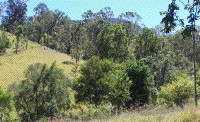
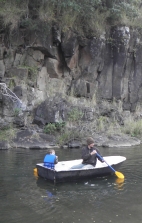
After some intensive searching, we found it: 87 acres at the foot of Mt Chinghee near the Queensland-NSW border, about a third covered in fairly mature rainforest regrowth, and almost another third in regrowth, adjacent to Mt Chinghee National Park (which harbours seasonally-dry rainforest) and with views to Border Ranges National Park and Lamington National Park. It borders one kilometre of Running Creek (which has never stopped running in even the worst of droughts), and is just a 90 minute drive to either Brisbane or the Gold Coast. Steep slopes that were covered largely in weeds and land-slips are now on their way back to being rainforest.
 We began running
ecotours in May 1997, with just one product, the 3-day
wildlife tour, in a 5-seater vehicle, advertised by
photocopied fliers to backpacker hostels. Soon after,
we purchased an 8-seater minibus, started our first website,
and achieved eco-accreditation for our tour.
Travellers who could not stay in Queensland long enough for
our 3-day tour started asking about day-tour possibilities,
so we added three of these (bird-watching, bush-walking and
Coochiemudlo Island) and soon had advanced eco-accreditation for all four
tours. We achieved our first tourism
award in 2002 and have won other awards since then.
All our tours have now achieved advanced eco-accreditation.
We began running
ecotours in May 1997, with just one product, the 3-day
wildlife tour, in a 5-seater vehicle, advertised by
photocopied fliers to backpacker hostels. Soon after,
we purchased an 8-seater minibus, started our first website,
and achieved eco-accreditation for our tour.
Travellers who could not stay in Queensland long enough for
our 3-day tour started asking about day-tour possibilities,
so we added three of these (bird-watching, bush-walking and
Coochiemudlo Island) and soon had advanced eco-accreditation for all four
tours. We achieved our first tourism
award in 2002 and have won other awards since then.
All our tours have now achieved advanced eco-accreditation.When a beautiful new Bed-and-Breakfast, Cougal Park, opened much closer to our house than the accommodation we originally used (Mt Barney Lodge: still a good place to stay), we switched to this, as Cougal is much closer to home and to rainforests with a good networks of walking tracks, and also a bit closer to the coast, enabling u
 s to add sandy
beaches, rocky headlands and mangroves to the tour.
s to add sandy
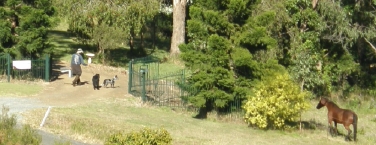
beaches, rocky headlands and mangroves to the tour. We celebrated the tenth anniversary of Araucaria Ecotours ion 2007 with an open day for our wildlife ecology centre, butterfly trail, creek activities and 4WD trip up the hill to the rainforest regeneration area (some of the party crowd, including the mayor of Beaudesert Joy Drescher, in the photo to the right). We missed the chance for a 20-year celebrati0on, and plan to have some specials forour 25th anniversary instead.
Our tour vehicle
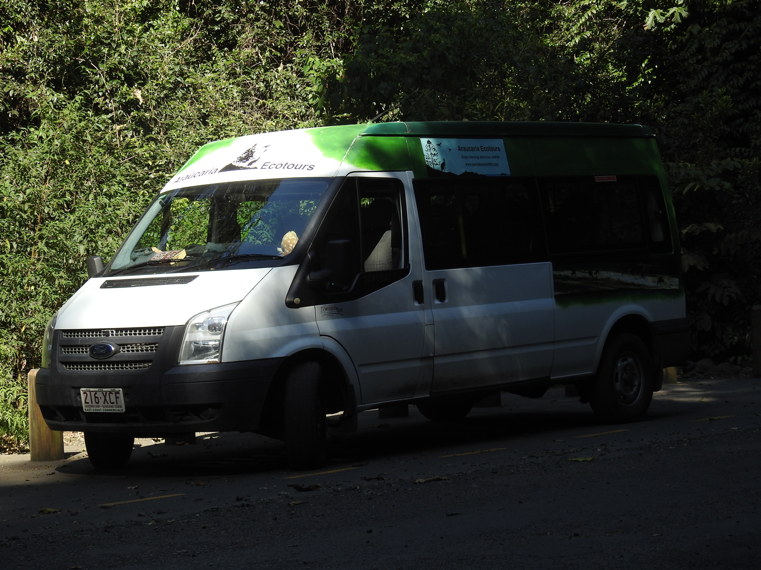

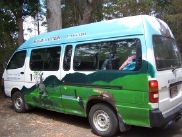
Our usual vehicle is a 12-seater, air-conditioned Ford Transit.
We tow a covered, lockable trailer when needed, but there is usually ample room in the "cage" at the back of the vehicle. We can also bring a baby seat or a collapsible wheelchair as needed.
Community
involvement
The Araucaria team are engaged most weeks in some kind of
community work, mostly to do with wildlife
conservation. We are especially active in Wildlife Tourism
Australia and Wildlife Queensland (mostly Scenic
Rim branch), and represent these in other community
events.Ronda also acts as mentor to students from Griffith University, and we sometimes provide work experience to students.
Darren gives free public performances of his piano compositions to community events such as Arts Dinners and the Drumley Walk, and Ronda and Darren do heavily discounted fauna surveys for conservation groups.
Conservation-related
Research
Ronda conducts research into the dispersal of seeds by
fruit-eating animals, and has in the past conducted research
into effects of habitat modification on wildlife, urban
wildlife, chimpanzee play behaviour and wildlife tourism. See publications by Ronda hereWe also contribute to research by others:
- Climate Watch - flowering and fruiting times of selected trees and other plants, breeding and migratory observations of selected mammals, birds, reptiles and insects, recorded onto the Climate Watch app, where all data will ultimately be analyzed for year-to-year seasonal changes to see if they change as would expected in response to climate change.
- Sightings of wildlife within the Scenic Rim on a
database for the Scenic Rim branch of the WIldlife
Preservation Soociety of Queensland.
- Passing on of other relevant observations to
researchers and to databases such as Wildlife Online,
Atlas of Living Australia and iNaturaist.
Music and
interpretive aids
Nature Interpretation products/services (computer programs, videos, signs, written materials)
Denis Green has
written a bird call quiz which has proved very popular
at the Lamington Natural History Association's
Information Centre at Binna Burra (at the edge of
Lamington National Park). Ronda wrote an extensive
natural history information program for the same
computer, using photos taken by herself, Darren Green and
Lesley Hutley (former LNHA president)
Ronda Green has designed a number of nature trails and published 'Guidelines to the Preparation of Nature Trails through the Australian Conservation Foundation. She has had long experience in nature interpretation for all ages, and is currently expanding the displays in the Scenic Rim Wildlife Ecology Centre and associated nature trails on the Araucaria property
We are available for consultation on the development of interpretive materials, including nature trails and computer programs
Ronda Green has designed a number of nature trails and published 'Guidelines to the Preparation of Nature Trails through the Australian Conservation Foundation. She has had long experience in nature interpretation for all ages, and is currently expanding the displays in the Scenic Rim Wildlife Ecology Centre and associated nature trails on the Araucaria property
We are available for consultation on the development of interpretive materials, including nature trails and computer programs
Musical composition and performance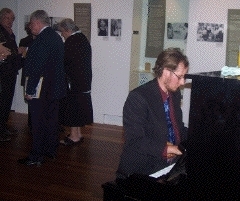
Darren Green showed
talent for music at an early age when we got our first
piano and at age three, barely able to see above the
keyboard, he started working out not just simple
melodies but quite complex ones. He has played
violin, guitar and recorder but his favourite instrument
is the piano, on which he writes many of his own
compositions. He also composes on an electronic keyboard
(solar-powered of course) and an Apple computer. He has
studied musical composition at tertiary level and gets
something akin to withdrawal symptoms if away from a
piano for more than a couple of days. He now
performs his own compositions in various public venues.
He can be contacted on 07
55441283 for performances and for consultation on
possibilities for composing music for videos (especially
nature videos), games and other projects.