 |
|||||||||||||||
|
|||||||||||||||
 |
|
 |
|||||||||||||
Some of the species seen in the wild on our tours:
Mammals Birds Reptiles Amphibians Fish Invertebrates Plants(Click here for the animals we see at the David Fleay Wildlife Park )
See also: Australian wildlife Wildlife of the Scenic Rim Wildlife conservation and wildlife tourism
 Mammals seen
in the wild on our tours
Mammals seen
in the wild on our tours
Most
Australian mammals are nocturnal, but some become
active in the late
afternoon and are still foraging for a short time
after dawn.
Some are very easy for us to find on tour, others make less predictable appearances now and then.
Click here for further information on Australian mammals and local (Scenic Rim) wildlife, including mammals
Monotremes
Some are very easy for us to find on tour, others make less predictable appearances now and then.
Click here for further information on Australian mammals and local (Scenic Rim) wildlife, including mammals
Monotremes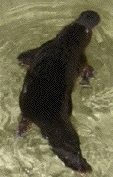
- platypus
(more predictable in breeding season July -
December), often seen on
3-day Australian wildlife overview
tour, sometimes on
birdwatching tour - also seen in
captivity on on 3-day wildlife
tour and with prior request on bush walking
and wildlife day-tours)
- echidna (occasionally)
Marsupials
- brush-tailed phascogale (very rarely)
- yellow-footed antechinus (occasionally)
- long-nosed bandicoot (occasionally)
- northern brown bandicoot (fairly often)
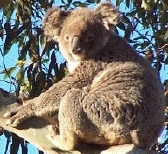
- koala - usually seen in the in wild on 3-day wildlife overview tour and wildlife day-tour, occasionally on bush walking or birding tour (always seen in captivity on 3-day and 1-day wildlife tours, and on bush walking tours on request)
- greater glider (occasionally - and usually seen in captivity at wildlife park)
- ring tail
possum - occasionally on wildlife day-tour
- yellow-bellied glider (very rarely in wild - usually seen in captivity on 3-day wildlife tour)
 sugar
glider
(occasionally), very rarely
on 3-day wildlife
tour or
wildlife day-tour
sugar
glider
(occasionally), very rarely
on 3-day wildlife
tour or
wildlife day-tour
- squirrel glider (occasionally – it’s not a squirrel, but a gliding possum with a bushy tail), very rarely also seen on wildlife day-tour
- feather-tail glider (only seen once so far on tour)
- common brushtail possum (almost always on 3-day tour, often on wildlife day-tour)
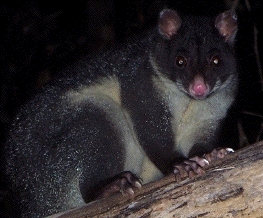
- bobuck or mountain brushtail (occasionally - pictured to right)
- rufous bettong (occasionally)
- red-necked pademelon (fairly often on 3-day tour, often on birding tours)
- red-legged pademelon (occasionally)
- red-necked wallaby (always on 3-day and 1-day wildlife tours)
- whip-tail wallaby (almost always on 3-day wildlife, sometimes on birding day-tour)
- eastern grey kangaroo (always)
- swamp wallaby (occasionally)
 Placentals
- swamp rat (very rarely - usually only active under vegetation at night, and small)
- Melomys
(very rarely- usually only active under vegetation
at night, and small)
- microbats (fairly often but briefly)
- black
flying fox - almost always (on wildlife
day-tour as well as 3-day)
- little red flying-fox - almost always (on wildlife day-tour as well as 3-day)
- grey-headed flying-fox - almost always (on wildlife day-tour as well as 3-day)
- bottle-nosed
dolphin
–
(usually,
viewed
from
cliffs on
3-day wildlife tour)
- humpbacked whale – (occasional,distant, viewed from cliffs on 3-day wildlife tour May – Oct)
top of page
Birds seen in the wild on our tours
We always see a good variety, and some are very predictable, others cannot be guaranteed and some just turn up occasionally.Click here for further information on Australian birds and local (Scenic Rim) wildlife, including birds
Non-passerines
- emu (outback tour or custom tours only - always seen on outback tour)
- Australasian
gannet
(occasionally on 3-day wildlife
tour )
- brush turkey (often on 3-day tour, always on birding tours that include Lamington NP)
- brown quail (fairly often)
- black-breasted button-quail (very rarely)
- pelican (fairly often on 3-day tour, almost always on birding tour and island tour, often on wildlife day-tour)
- little pied cormorant (often, on 3-day tour, island tour, wildlife day-tour and birding tour )
- pied
cormorant (often, on 3-day tour, island tour and
birding tour)
- black cormorant (fairly often, on 3-day tour, island tour and birding tour)
- little black cormorant (often, on 3-day tour, island tour, wildlife day-tour and birding tour)
- darter (fairly often, on 3-day tour, island tour, wildlife day-tour and birding tour)
- little grebe (usually on 3-day tour, almost always on birding tour)
- black-necked stork (occasionally - also seen captive in the wildlife park)
- black duck (always, most tours)
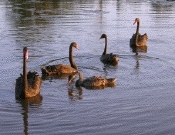
- black swan (fairly often on 3-day and 1-day wildlife tour, almost always on birding tour)
- grey teal (fairly often on 3-day tour, almost always on birding tour)
- plumed whistling duck ( always at the wildlife park - not captive but coming in of their own accord, sometimes see in other places also on 3-day wildlife or birding day-tour)
- wandering whistling duck (occasionally)
- wood duck (always, most tours)
- magpie goose (occasionally on birdwatching tours and almost always at the wildlife park - not captive but coming in of their own accord, and )
- dusky moor-hen (always)
- Eurasian coot (always)
- purple swamphen (almost always)
 bush
stone-curlew (almost
always on island tour)
bush
stone-curlew (almost
always on island tour)- brolga (outback tour only - also in captivity on 3-day wildlife tour)
- buff-banded
rail
(very
rarely)
- Lewin’s rail (very rarely)
- spotless
crake (outback tour only)
- nankeen night-heron (usually at the wildlife park - not captive but coming in of their own accord, other places very occasionally)
- white-faced heron (almost always, on 3-day wildlife and birding day-tour)
- white-necked heron (fairly often, on 3-day wildlife and birding day-tour)
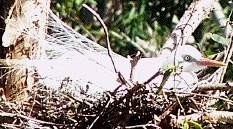
- cattle egret (always)
- intermediate egret (fairly often)
- little egret (fairly often)
- great
egret (fairy often)
- yellow-billed spoonbill (fairly often on birding day-tour as well as 3-day wildlife)
- royal spoonbill (often on 3-day wildlife and birding day-tour)
- white ibis (almost always, on Coochiemudlo day-tour as well as 3-day wildlife, always also at the wildlife park - not captive but coming in of their own accord)
- strawnecked ibis (almost always)
- glossy ibis (occasionally on 3-day wildlife and birding day-tour)
- black-winged stilt (often, on 3-day wildlife and birding day-tour)
 comb-crested jacana
(fairly often)
comb-crested jacana
(fairly often)- masked lapwing (always)
- red-kneed dotterell (occasionally)
- black-fronted
dotterell
(occasionally)
- Lathan’s snipe (occasionally)
- red-necked
avocet (very rarely on birding tour)
- pied oyster-catcher (occasionally on island tour)
- caspian tern (fairly often)
- silver
gull (always, 3-day tour and island tour)
- brown falcon (fairly often)
- peregrine falcon (very rarely)
- Australian hobby (very rarely)
- nankeen kestrel (almost always)
- Pacific baza (fairly often)
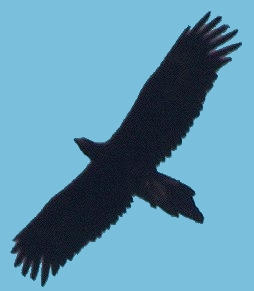
- wedge-tailed eagle (fairly often)
- little
eagles (occasionally on outback tour)
- whistling
kite (occasionally on
3-day wildlife,
fairly often on island day-tour and outback
tour)
- black-shouldered kite (often)
- white-breasted sea-eagle (occasionally on 3-day wildlife, fairly often on island day-tour)
- brahminy kite (fairly often on island day-tour)
- black kite (outback tour only - always)
- square-tailed kite (occasionally)
- grey goshwak (very rarely)
- brown
goshawk (rarely)
- osprey
(fairly often
on
3-day
wildlife
and
island
day-tour, usually seen nesting on
3-day wildlife
tour in winter)
- brown goshawk (occasionally)
- brown cuckoo dove (usually, on 3-day wildlife and birding day-tour)
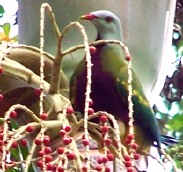 wompoo
fruitdove (fairly
often - but more often heard than seen,
especially in warmer months)
wompoo
fruitdove (fairly
often - but more often heard than seen,
especially in warmer months)- rose-crowned
fruitdove
(occasionally
-
more
often
heard than seen)
- crested pigeon (always)
- bar-shouldered dove(almost always, on 3-day wildlife and birding day-tour)
- diamond dove (outback tour only)
- emerald dove (rarely)
- wonga pigeon (often on birding day-tour)
- white-headed
pigeon
(fairly
often)
- crimson rosella (almost always, on 3-day wildlife and birding day-tour)
- eastern rosella (almost always on 3-day wildlife tour )
- pale-headed rosella (always on 3-day wildlife tour )
- galah (always on 3-day wildlife tour )
- king parrot (fairly often, on 3-day wildlife and birding day-tour)
- Bourke's parrot (very occasionally - outback tour only)
- rainbow lorikeet (always, on 3-day wildlife and birding day-tour, also Coochiemudlo and bush walking day-tours)
- scaly-breasted lorikeet (almost always, on 3-day wildlife and birding day-tour)
- Australian (Eastern) ringneck parrot (outback tour only)
- blue bonnet parrot (outback tour only)
- red-rumped parrot (outback tour only)
- red-winged parrot (outback tour only)
- mulga parrot (outback tour only)
- red-tailed
black cockatoo (occasionally on
3-day wildlife
tour and birding tours)
- glossy
black cockatoo (rarely)
- yellow-tailed black cockatoo (fairly often on 3-day wildlife tour and birding tours)
- little corella cockatoo, (sometimes on 3-day wildlife tour or day-tours, always on outback tour)
- sulphur-crested cockatoo (almost always, on 3-day wildlife and birding day-tour)
- Major Mitchell cockatoo (outback tour only- almost always)
- channel-billed cuckoo (often in warm months on 3-day wildlife tour and day-tours)
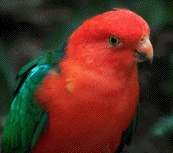 koel
(often in warm
months, more often heard than seen, on
3-day wildlife and
birding day-tour)
koel
(often in warm
months, more often heard than seen, on
3-day wildlife and
birding day-tour)- fantailed cuckoo (occasionally, on 3-day wildlife and birding day-tour)
- brush cuckoo (more often heard than seen, spring and summer, on 3-day wildlife and birding day-tour)
- pallid cuckoo, more often heard than seen, spring and summer, on 3-day wildlife and birding day-tour)
- shining bronze-cuckoo (rarely, on 3-day wildlife and birding day-tour)
- Horsefield's bronze-cuckoo (rarely, outback tour)
- pheasant coucal (almost always on 3-day wildlife tour )
- shining Bronze-cuckoo (rarely)
- barn owl (almost always on 3-day wildlife tour )
- boobook owl (fairly often on 3-day wildlife tour and wildlife day tour, heard far more often than seen)
- tawny frog-mouth (fairly often on 3-day, occasionally on wildlife day-tour)
- marbled frog-mouth (very occasionally on 3-day wildlife tour )
- owlet nightjar (very occasionally on 3-day wildlife tour )
- white-throated nightjar (very occasionally heard at night on 3-day wildlife tour )
- dollarbird (almost always in warm months, on most tours)
- rainbow
bee-eater (occasionally on 3-day wildlife tour,
birding tour and
outback tour)
- forest kingfisher (fairly often, on 3-day wildlife and birding day-tour)
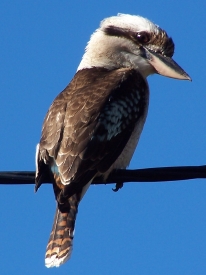 sacred
kingfisher
(fairly often, on 3-day wildlife
and
birding day-tour)
sacred
kingfisher
(fairly often, on 3-day wildlife
and
birding day-tour)- azure kingfisher (fairly often on 3-day wildlife tour )
- mangrove kingfisher (occasionally, on 3-day wildlife and island day-tour)
- laughing kookaburra (almost always, on all tours)
Passerines
- Albert's
lyrebird (occasionally on 3-day wildlife tour or
birding tour - more
often heard than seen)
- noisy pitta (occasionally, on 3-day wildlife and birding day-tour)
- log-runner (occasionally on 3-day wildlife tour, often on birding day-tour)
- apostlebird (outback tour only - always)
- white-winged chough (outback tour only - occasionally)
- varied sitella (occasionally on 3-day wildlife tour and birding tours)
- white-throated tree-creeper (fairly often, on 3-day wildlife, bush walking and birding day-tour)
- red-backed fairy-wren (often, on 3-day wildlife and birding day-tour)
- variegated fairy-wren (often, on 3-day wildlife and birding day-tour)
- superb fairy-wren (fairly often on 3-day wildlife tour and birding tours)
- brown gerygone (almost always, on 3-day wildlife and birding day-tour)
- white-throated gerygone (often, on 3-day wildlife and birding day-tour)
- buff-rumped thornbill (occasionally on 3-day wildlife tour )
- striated thornbill (occasionally on 3-day wildlife tour )
- brown thornbill (almost always, on 3-day wildlife and birding day-tour)
- white-browed scrub-wren (almost always, on 3-day wildlife and birding day-tour)
- yellow-throated scrubwren (often, on 3-day wildlife and birding day-tour, nest often seen also)
- large-billed scrubwren (occasionally, on 3-day wildlife and birding day-tour)
- striated pardalote (often - more often heard than seen, on 3-day wildlife and birding day-tour)
- spotted pardalote (often - more often heard than seen, on 3-day wildlife and birding day-tour)
- Richard's
pipit (occasionally, 3-day wildlife tour and
outback tour)
- brown songlark (occasionally, outback tour)
- silvereye
(often on most tours)
- bell miner (always on 3-day wildlife, almost always on birding day-tour)
- blue-faced honeyeater (very often, on 3-day wildlife and birding day-tour)
- Lewin’s Honeyeater (almost always on 3-day wildlife and birding day-tour)
- noisy miner (always on all tours)
- noisy friarbird (almost always on 3-day wildlife and birding day-tour)
- little friarbird (often on 3-day wildlife tour and birding tours)
- singing honeyeater (outback tour only)
- yellow-faced honeyeater (often on birding tours and on 3-day wildlife tour )
- blue-faced
honeyeater (often on
3-day wildlife
tour and birding tours)
- white-throated honeyeater (often on 3-day wildlife tour and birding tours)
- white-plumed honeyeater (outback tour only)
- spiny-cheeked honeyeater (occasionally, outback tour only)
- scarlet honeyeater (fairly often in cooler months on 3-day wildlife tour ad birding tours)
- brown
honeyeater (fairly often on
3-day wildlife
tour and birding tours)
- eastern
spinebill (often on
3-day wildlife
tour and birding tours)
- orange chat ((outback tour only - very occasionally)
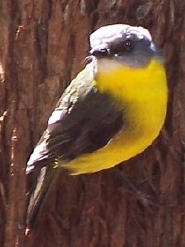 eastern
whipbird (almost always, on
3-day wildlife and
birding day-tour - more often heard than seen)
eastern
whipbird (almost always, on
3-day wildlife and
birding day-tour - more often heard than seen)- grey-crowned babbler (occasionally on 3-day wildlife tour )
- jacky winter (occasionally on 3-day wildlife tour )
- red-capped robin (occasionally, outback tour)
- pale yellow robin (occasionally, birding day- tour)
- eastern yellow robin (almost always on 3-day wildlife and birding day-tour) – NOTE: none of our 'robins' are related to Northern Hemisphere robins
- grey shrike-thrush (often, on 3-day wildlife and birding day-tour)
- little shrike-thrush (occasionally on 3-day wildlife tour )
- golden whistler (fairly often, on 3-day wildlife and birding day-tour)
- rufous whistler (fairly often on 3-day wildlife tour)
- crested shrike-tit (very occasionally on birding day-tour)
- black-faced monarch (occasionally, on 3-day wildlife and birding day-tour)
- spectacled monarch (occasionally, on 3-day wildlife and birding day-tour)
- magpie-lark
(always),
all
tours
- grey fantail (almost always, on 3-day wildlife and birding day-tour)
- rufous fantail (often, on 3-day wildlife and birding day-tour)
- willy wagtail (always, all tours)
- restless
flycatcher (occasionally
on 3-day wildlife
tour and
birding tours)
- leaden flycatcher (occasionally on 3-day wildlife tour and birding tours)
- spangled drongo (fairly often)
- figbird (almost always, on 3-day wildlife and birding day-tour)
- olive-backed oriole (often, on 3-day wildlife, bush walking, island and birding day-tour)
- catbird (fairly often, on 3-day wildlife and birding day-tour - more often heard than seen, heard mostly in spring and summer)
- regent bowerbird (occasionally on 3-day wildlife, often on birding day-tour)
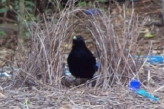 satin bowerbird
(often on
3-day
wildlife
and
birding
day-tour)
satin bowerbird
(often on
3-day
wildlife
and
birding
day-tour)- black-faced cuckooshrike (almost always on 3-day wildlife and birding day-tour)
- spotted bowerbird (rarely, outback tour)
- varied triller (occasionally on 3-day wildlife and birding day-tour)
- Australian magpie (always, all tours)
- pied butcherbird (almost always, all tours)
- grey butcherbird (almost always, on 3-day and 1-day wildlife and birding day-tour)
- pied currawong (almost always, on 3-day wildlife and birding day-tour)
- Paradise riflebird (fairly often on birding day-tour, occasionally ion 3-day wildlife tour)
- spangled
drongo - often
- white-breasted woodswallow (outback tour only)
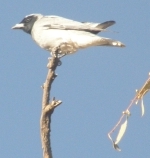 white-browed
woodswallow (outback tour only)
white-browed
woodswallow (outback tour only)- masked woodswallow (outback tour only)
- Torresian crow (always, all tours)
- welcome swallow (always, most tours)
- tawny grassbird (occasionally on 3-day wildlife tour and birding tours)
- golden-headed
cisticola
(occasionally,
3-day
wildlife
and
birding day-tour)
- double-bar finch (occasionally on 3-day wildlife tour )
- chestnut-breasted mannikin (occasionally)
- red-browed finch (often on 3-day wildlife tour and birding tours)
- Bassian thrush (occasionally, birding day-tour)
top of page
 Reptiles seen
in the wild on
our tours
Reptiles seen
in the wild on
our tours
Click
here for
further information on Australian
reptiles and local (Scenic
Rim) wildlife, including reptiles
Turtles
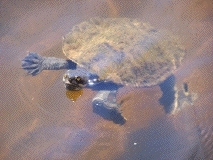
- short-necked turtle (almost always, in warm months, on 3-day wildlife and wildlife day-tour)
- long-necked
turtle
(rarely)
- marine
turtle (unidentified - seen occasionally from
cliffs during 3-day tour)
Lizards
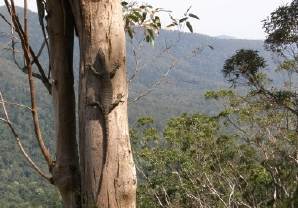 robust
velvet gecko (very
occasionally on 3-day wildlife
tour )
robust
velvet gecko (very
occasionally on 3-day wildlife
tour )- bearded dragon (often, on 3-day wildlife, island and birding day-tour)
- central
Australian bearded dragon (fairly often, outback
tour only)
- southern angle-headed dragon (occasionally on 3-day wildlife tour )
- Gilbert's dragon (occasionally, outback tour only)
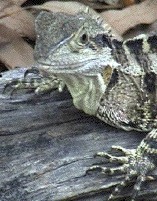
- eastern water dragon (often, on 3-day wildlife and birding day-tour)
- other dragon lizards (occasionally)
- lace monitor (often on 3-day wildlife in warmer months, sometimes on birding and other day-tours)
- sand
monitor (fairly often, outback tour only)
- major
skink (fairly often on
3-day wildlife
tour )
- land mullet (fairly often on 3-day wildlife and birding day-tour)
- pink-tongued skink (occasionally on 3-day wildlife tour )
- shingleback lizard (outback tour only - occasionally)
- wall skink (almost always, many tours)
- delicate skink (often on 3-day wildlife tour )
- secretive skink (occasionally on 3-day wildlife tour )
- other skinks (often)
Snakes
 small-eyed
snake
(occasionally) – shy snake, usually seen from bus
window at night on 3-day wildlife
tour
small-eyed
snake
(occasionally) – shy snake, usually seen from bus
window at night on 3-day wildlife
tour - yellow-faced
whip-snake
(occasionally)
–
shy
snake,
sometimes suns itself on grass, seen on
3-day wildlife
tour and wildlife day-tour
- red-naped snake (very rarely)
- Stephen’s banded snake (rarely)
- eastern brown snake (very rarely)
- red-bellied
black
snake
(occasionally)
- bandy-bandy
(rarely)
- golden-crowned snake (occasionally)
- green tree snake (occasionally) – non-venomous
- brown tree snake (occasionally) – has venom but being rear-fanged cannot easily bite humans
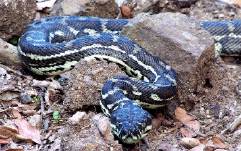
- carpet python (fairly often on 3-day wildlife and sometimes on wildlife day-tour or birding day-tour or outback tour) – non-venomous
- spotted python (very rarely) – non-venomous
top of page
Amphibians seen in the wild on our tours
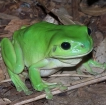 Frogs are mostly seen on warm wet nights, and are more
often heard than
seen
Frogs are mostly seen on warm wet nights, and are more
often heard than
seen- broad-palmed rocket frog Litoria latopalmata (fairly often)
- eastern sedgefrog Litoria fallax (fairly often)
- green tree frog Litoria caerula (often)
- stony creek frog Litoria leseuri (fairly often)
- striped rocket frog Litoria nasuta (fairly often)
- naked or purple tree frog Litoria rubella (often)
- emerald-spotted tree-frog Litoria peronii (occasionally)
- striped marsh-frog Lymnodynatses peronii (fairly often)
- spotted marsh-frog Lymnodynatses tasmaniensis (fairly often)
- ornate burrowing frog Lymnodynatses ornatus (fairly often)
- scarlet-sided pobblebonk Lymnodynatses terraeginae (occasionally)
- great barred frog Mixophyes fasiculatus (heard fairly often, seen occasionally)
- holy
cross
'toad' (not really a toad) - seen once on
outback tour
- (plus others we hear at night, varying with season and weather but always something calling)
- (also the introduced cane toad Bufo marinus, almost always
top of page
 Fish
seen in the wild
on our tours
Fish
seen in the wild
on our tours
- long-finned eel (often)
- eel-tailed catfish (also called dewfish) (often – sometimes in summer we see their nests)
- Australian smelt (often)
- freshwater mullet (often)
- striped
gudgeon (occasionally)
- stingrays,
manta rays
(occasionally from cliffs at Fingal on 3-day tour)
- various
other marine fish - in mangroves, tidal pools or
shallow sandy shore
Invertebrates seen in the wild on our tours
Insects
 Butterflies
- wanderer (not native, the “monarch” of North America) (almost always - very conspicuous and common)
- lesser wanderer (often)
- blue tiger (fairly often – sometimes in large numbers)
- common crow (often)
- common brown (fairly often)
- common eggfly (fairly often)
- blue triangle (occasionally)
- orchard swallowtail ( often, one of Australia's largest butterflies)
- Richmond birdwing butterfly (very occasionally)
- evening brown (often)
- jezebel (occasionally)
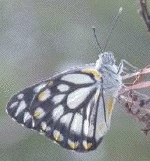
- caper white (fairly often – sometimes in large numbers) - pictured to right
- common yellow (often)
- lemon
migrant (sometimes)
- various blues (almost always
- regent
skipper (occasionally)
- various
others, including caterpillars and pupae as well
as adults
Other insects
- Glow worms (not really worms but the larvae of small gnats)
- Native stingless bees - see on almost all our visits to Daisy Hill and Redlands Indigiscapes, also often visiting native flowers in many areas
- Meat
ants
- large mounds covered in tiny sticks and pebbles
to protect it from
eroding in the heavy rain
- Phasmids - we fairly often see large stick insects
- Praying mantids - various sizes, green ones and brown ones, often
- Many
others
Spiders (mostly harmless, some only active at night)
- huntsman spiders (big but not dangerous)
- wolf spiders (bright eye-shine at night, big but not dangerous)
- golden orb-weaver (sometimes very big, but not dangerous)
- other orb-weavers
- leaf-curl spider
- water spider
- giant water spider
- spiny spider
- crab spiders
- jumping spiders
- St Andrew’s cross spider
- trapdoor spiders (burrows seen on some tours)
- funnel-web (funnels sometimes seen on day-tours to Lamington NP, and spider seen once on tour)
- various others
Are our spiders dangerous?
Not
as much as some
would think.
The spider that has caused the most fatalities in Australia (13 since white settlement) is the Sydney funnel-web. Our local funnel-webs have as yet not been known to cause any deaths. They are not generally active during the day, and even at night you’d have to try pretty hard to get bitten. There have been deaths from redback spiders, but all were before 1955, when the antivenin was developed.
The spider that has caused the most fatalities in Australia (13 since white settlement) is the Sydney funnel-web. Our local funnel-webs have as yet not been known to cause any deaths. They are not generally active during the day, and even at night you’d have to try pretty hard to get bitten. There have been deaths from redback spiders, but all were before 1955, when the antivenin was developed.
Other invertebrates
- Lamington
spiny cray - a beautiful blue creature -
is sometimes seen in
the rainforest creeks of the Lamington National
Park, or even
wandering on the tracks
- A similar and closely-related but red and white freshwater cray is sometimes seen in the rainforest creeks of the Border Ranges National Park, sometimes wandering on the tracks
- Small crabs of various species are seen in the mangroves near the David Fleay Wildlife Park and on the island day-tour
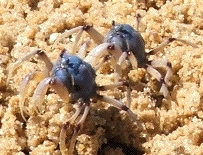
- soldier
crabs (island day-tour, often in thousands - see
photo)
- Land snails, or more commonly their shells (some much larger than garden snails), are sometimes found in the rainforest, including some of Gondwanan ancestry. Patterns made by triangle slugs are seen on eucalypts, and occasionally the slug itself
- Various molluscs, jellyfish, sponges and other creatures are sometimes washed onto the beach at Fingal or Coochiemudlo, jellyfish are sometimes seen in the sea, and at low tide we can see chitons, galeolaria worms and other rocky shore animals
- Flatworms, large earthworms and other creatures turn up from time to time in the forests
top of page
Plants seen on our tours
Flowering
plants
Eucalypts and their relatives
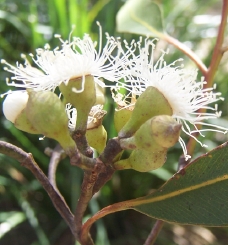 the
typical Australian gumtree - the Eucalyptus.. There
are hundreds of different species, but can
conveniently be grouped into smooth-barked gums,
stringy-barks and
iron-barks - all three groups are seen on most
of our tours
the
typical Australian gumtree - the Eucalyptus.. There
are hundreds of different species, but can
conveniently be grouped into smooth-barked gums,
stringy-barks and
iron-barks - all three groups are seen on most
of our tours
- very closely related, and seen on most tours, are the Corymbia species (spotted gums and blood-woods), apple gums (Angophora), brush boxes (Lophostemon) and water gums (Tristaniopsis)
- in
the
same family, with dry fruits and mostly in open
forests and woodlands,
are bottle-brushes and tea-trees, seen on most
tours
- in the same family, with fleshy fruits and mostly in rainforests, are the lillypillies (wide variety of size, shape and colour of fruits) - seen on all rainforest tours and some others
Figs
Several species of strangler fig plus other species - seen on all rainforest tours and some others
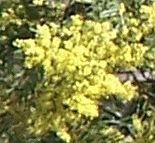 Wattles
Acacia in Australia is generally known as 'wattle', and there are hundreds of species. Seen on all tours. Mulga and brigalow seen on outback tours.
Palms
Bangalow (picabeen) and walking stick palms are seen on all rainforest tours
Many others
Many trees, shrubs, vines, forbs, grasses and mistletoes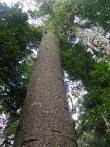
Conifers
- Araucaria
-
the
bunya (Bunya and some other tours - see photo) and
hoop pine (most
tours)
- Callitris
(similar
to cyprus) - outback and some other tours
- Cycads (some tours, especially glow worm tour if full walk done at Witches Falls)
Ferns
- Tree ferns - several species on rainforest and some other tours
- Epiphytic
ferns
-
elkhorns, staghorns, crows nests, haresfoot fern,
others, mostly on
rainforest tours
- Many other ferns, especially on rainforest tours
Fungi seen on our tours
- Bracket fungi - common on logs and treetrunks, various species, especially in the rainforest
- mushrooms and toadstool - many species, especially in autumn
- puffballs
- lichens (symbiotic relationship between fungi and algae) - various kinds on trees and rocks, some looking like paint splashes, some hanging down from branches
Captive animals seen at the David Fleay Wildlife Park on our 3-day wildlife overview tour:
 platypus
- Julia
Creek dunnart (an outback species)
- bilby (an outback species)
- mahogany glider (found only in northern Queensland)
- yellow-bellied glider
- greater glider
- koala
- Proserpine rock wallaby (found only in northern Queensland)
- bridled nail-tail wallaby
- Lumholtz tree-kangaroo (found only in northern Queensland)
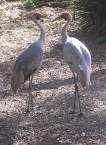
- brolga
(Australia's crane - see photo)
- black-necked stork
- wedge-tailed eagle
- barking owl
- tawny frog-mouth
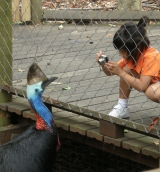 cassowary
(found only in
northern Australia - see photo)
cassowary
(found only in
northern Australia - see photo)- carpet python
- southern angle-headed dragon
- freshwater
crocodile (found only in northern Australia)
- saltwater crocodile (found only in northern Australia and tropical Asia)
There are also species that bring themselves in from the surrounding forests and wetlands - e.g. red-legged pademelons, brush turkeys, nankeen night-herons, magpie geese, greater egrets, eastern water dragons and others
top of page