 |
||||||||||||
|
||||||||||||
South-east Queensland and North-eastern New South Wales |
||||||||||||
|
|
Mountains and forests |
|
||||||||||
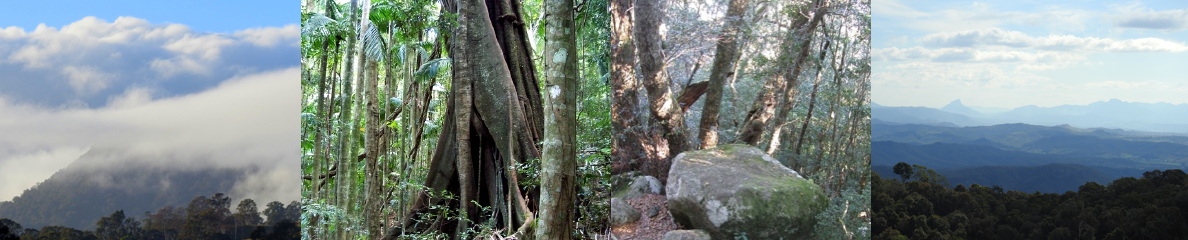  This eastern border
area of New South Wales and Queensland is part of
the Australia's third most biologically diverse
region (after the wet tropics of Far North
Queensland and the Stirling Ranges of southwest
Western Australia). This is partly because of the
Macleay-McPherson overlap, a geographical and
climatic zone including the far southeast corner
of Queensland and the far northeast corner of New
South Wales, resulting in a mingling of tropical
and temperate species of fauna and flora. Many
plant and animal species reach their northern or
southern limits here. Three gigantic
shield volcanoes (Main Range, Focal Peak and Mt
Warning) each erupted for about one million years
between 25 and 22 million years ago, forming an
arc of mountainous country extending from
Toowoomba just west of Brisbane. southwards
towards the border and then eastwards along the
border through Moogerah Peaks, Mt Barney and
Lamington National Parks to Springbrook. These
mountains now trap much of the moist air coming in
from the Pacific Ocean, and the volcanic rocks
have contributed many nutrients to the soil,
endowing the whole area with richer soils and
better rainfall than most of Australia. This eastern border
area of New South Wales and Queensland is part of
the Australia's third most biologically diverse
region (after the wet tropics of Far North
Queensland and the Stirling Ranges of southwest
Western Australia). This is partly because of the
Macleay-McPherson overlap, a geographical and
climatic zone including the far southeast corner
of Queensland and the far northeast corner of New
South Wales, resulting in a mingling of tropical
and temperate species of fauna and flora. Many
plant and animal species reach their northern or
southern limits here. Three gigantic
shield volcanoes (Main Range, Focal Peak and Mt
Warning) each erupted for about one million years
between 25 and 22 million years ago, forming an
arc of mountainous country extending from
Toowoomba just west of Brisbane. southwards
towards the border and then eastwards along the
border through Moogerah Peaks, Mt Barney and
Lamington National Parks to Springbrook. These
mountains now trap much of the moist air coming in
from the Pacific Ocean, and the volcanic rocks
have contributed many nutrients to the soil,
endowing the whole area with richer soils and
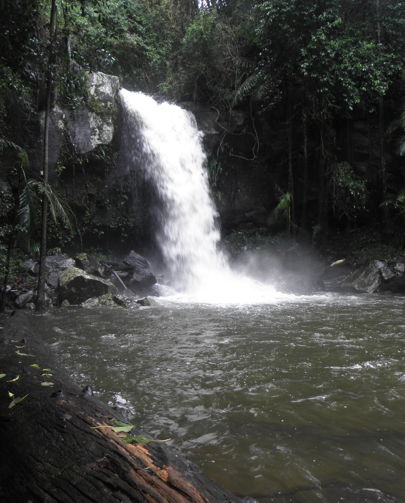
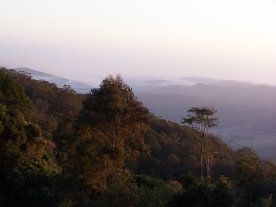
better rainfall than most of Australia.Habitats include cool-temperate forest with Gondwanan-linked Antarctic beech trees and a profusion of ferns and mosses on the mountain tops, lush palm gullies and massive trees in the warm subtropical rainforest, and “dry rainforest” (where plants are adapted to winter droughts on the western slopes, in a "rain shadow" of the high country to the east, which has first serve of the clouds rolling in from the Pacific Ocean). There are also several kinds of eucalypt forest, ranging from low mallee heath to tall majestic forests, as well as sheoak communities fringing creeks and rivers, mountain heathlands, swamps and lagoons, and other habitats. Birds tend to be active (and often vocal) most of the day in the rainforests (as compared to more open habitats where they tend to be quieter after mid-morning). Over half the bird species of Australia, including all of its raptors (eagles, falcons etc.) have been seen in this region. Migratory birds such as koels, channel-billed cuckoos, dollarbirds and rose-crowned fruitdoves and many wading birds visit regularly, while many others appear less predictably as nomads or vagrants. Many others are present year-round. 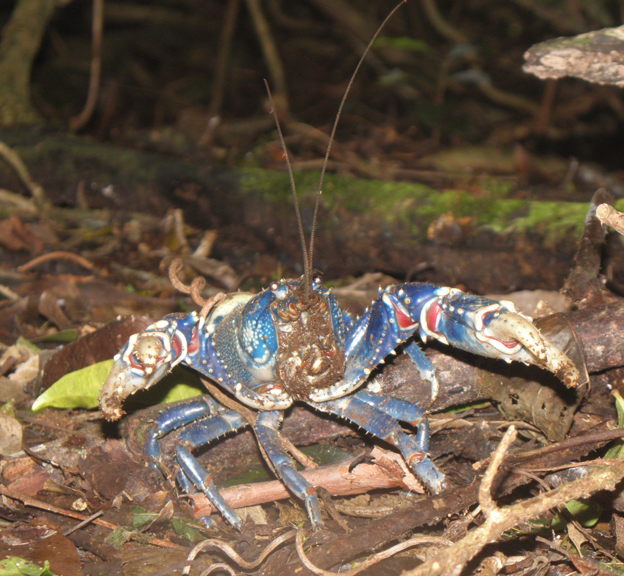 There are more mammal
species in this region than anywhere else in
Australia, including the country’s richest
diversity of macropods (members of the kangaroo
family), and some of iconic species such as koala
and platypus, as well as five species of gliding
possum and the largest mainland marsupial predator
(spotted-tailed quoll, a small relative of the
Tasmanian devil). A few local mammals are large
and conspicuous (eastern grey kangaroo, whiptail
wallaby) but many are small, shy and nocturnal,
and so rarely seen. There are more mammal
species in this region than anywhere else in
Australia, including the country’s richest
diversity of macropods (members of the kangaroo
family), and some of iconic species such as koala
and platypus, as well as five species of gliding
possum and the largest mainland marsupial predator
(spotted-tailed quoll, a small relative of the
Tasmanian devil). A few local mammals are large
and conspicuous (eastern grey kangaroo, whiptail
wallaby) but many are small, shy and nocturnal,
and so rarely seen. There is a rich diversity also of reptiles, frogs and other wildlife. Land-snails that trace their ancestry to Gondwana days are diverse, and colonies of glow worms (larvae of fungal gnats, NOT fireflies) can be seen at night on moist rocky ledges near creeks amid the fiorest. Many resident creatures are found nowhere else, including the hip-pocket frog (the male shelters the eggs and tadpoles in groinal skin-folds), Albert’s lyrebird (one of the world’s greatest mimics), the highly endangered Coxen's figparrot, the Lamington cray (a blue or red freshwater crayfish of mountain streams) and the Richmond birdwing (Australia's second-largest butterfly). |
||||||||||||
Beaches and marine LifeSurfers Paradise beaches are good for swimming amongst the crowds near high-rise buildings with night-life and restaurants. If you prefer quiet stretches of beach, there are more natural parts of the Gold Coast( e.g. Burleigh Heads), the Moreton Bay Islands or parts of the northern New South Wales coast. 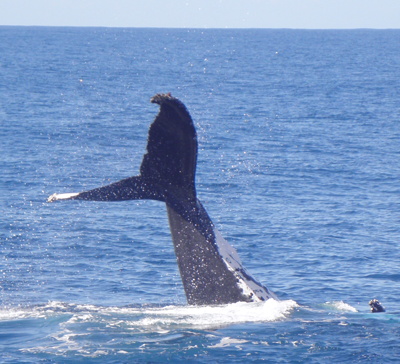 Humpback whales
migrate northwards through here from around May
to their breeding grounds in warm subtropical
and tropical waters, then pass through again
until October or November to return to the rich
feeding grounds of Antarctica. They can often be
seen from the coast on the mainland, or from
Stradbroke or Moreton or other Islands, and
there are several whale-watching tours. Dolphins
are often seen from many parts of the coast. Humpback whales
migrate northwards through here from around May
to their breeding grounds in warm subtropical
and tropical waters, then pass through again
until October or November to return to the rich
feeding grounds of Antarctica. They can often be
seen from the coast on the mainland, or from
Stradbroke or Moreton or other Islands, and
there are several whale-watching tours. Dolphins
are often seen from many parts of the coast.Dugongs, unusual among sea mammals in being herbivorous, reach their southernmost limit in eastern Australia in Moreton Bay. Sea turtles can be seen from coastal cliffs or while snorkeling at places such as Cook Island near Fingal. Small coral reefs fringe some of the islands, and the fish life, while not as diverse as the outer reef, is still colourful and impressive. There are also beautiful white sandy beaches, some sheltered and some with pounding surf, rocky cliffs and intertidal platforms with many kinds of small creatures adapted to life in this difficult habitat, and mangroves which provide breeding grounds for many creatures important to the food web of fish and other sea creatures. As the tide recedes on some island beaches, hundreds of blue soldier crabs emerge from burrows and trundle across the sand in search of food, soon heading back to safety before they themselves become food for shorebirds. All in all, much to delight the nature-lover! . |
||||||||||||
Please also visit:
BrisbaneScenic Rim Wildlife
Self-drive tours
Australia's Green Cauldron
Rainforest Way
Gondwana Rainforests of Australia
Scenic Rim
Tweed Tourism