 |
|||||||||||||||
|
|||||||||||||||
 Wildlife
of
the Scenic Rim, south-east Queensland
Wildlife
of
the Scenic Rim, south-east Queensland
 |
MammalsThere are 28 families of native mammals in Australia, some with just one species (e.g. platypus, koala), others with many species (e.g. kangaroos and waalabies, and some micorbat families)18 of these families are found within the Scenic Rim Highlights
include:
|
 |
|
Some
are
easy to see if you come at the right time
of day (e.g. kangaroos and wallabies at dawn or
dusk, brushtail possums
after dark), others take a bit
more time and patience, and some are
quite difficult to find without a lot of
patience, specialized
knowledge or luck.
|
||
 Native mammals of
the Scenic Rim include:
Native mammals of
the Scenic Rim include:- Monotremes (egg-layers)
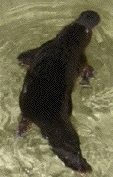
- platypus, that oddest of all mammals
(common in our
creeks)
- echidna (fairly common in places)
- Marsupials
(pouched
mammals)
- Carnivorous (from large-cat-size down to smaller
than
mice) -
spotted-tailed quoll (rare), brush-tailed
phascogale (uncommon),
antechinus (3 species: the very commonn
yellow-footed antechinus of more open forests and
drier rainforests,
subtropical antechinus of wetter rainforests and
the much rarer dusky
antechinus, also of rainforests), common dunnart
(not so very common,
mostly open habitats with grass and trees,
planigale (tiny, not often seen, open habitats)
- Omnivorous - bandicoots (two species: northern
brown and
long-nosed)
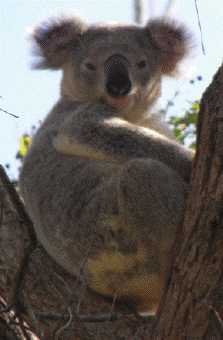
- Herbivorous - koala, several species of possums
(brush-tailed,
ringtail, eastern pigmy) and gliders (greater,
yellow-bellied, sugar,
squirrel, feathertail - i.e. 5 of Australia's six
species of gliding
possum),
long-nosed potoroos, rufous bettong, kangaroos
(eastern grey) and
several species of wallabies (red-necked,
whiptail, black-striped,
swamp, brush-tailed rock-wallaby, red-necked
pademelon, red-legged
pademelon
- Placentals
(young
born at
more advanced stage, as for most of the world's
mammals)
- Bats - fruitbats (flying foxes - grey-headed,
black and
little
red) and their relatives the blossom
bats and tube-nosed bats, many species of
microbats (the small,
insectivorous bats that navigate by echolocation)
in several families
- Rodents - bush rat, swamp rat, Melomys (2
species -
fawn-footed
and grassland), water rat, and the rare Hastings
River mouse, others
(also three species of introduced rodents)
- (the dingo is not truly native, but it has been
here a
long
time - probably for 3000-4000 years).
Rare and threatened mammals of the Scenic Rim:
 Pteropus
poliocephalus grey-headed
flying fox
is
considered
common
in
Queensland, Vulnerable nationally
Pteropus
poliocephalus grey-headed
flying fox
is
considered
common
in
Queensland, Vulnerable nationally- Kerivoula papuensis golden-tipped bat Rare
- Chalinolobus dwyeri large-eared pied bat Vulnerable
- Pseudomys oralis Hastings River mouse is considered vulnerable in Queensland, Endangered nationally
- Phascolarctos
cinereus
(south-east Queensland bioregion
race) koala This
race (not the koala species as a whole) is
considered Vulnerable in
Queensland, Endangered nationally
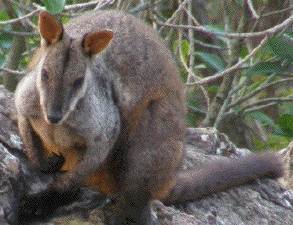
- Petrogale penicillata brush-tailed rockwallaby (pictured to right) Vulnerable
- Potorous tridactylus tridactylus long-nosed potoroo Vulnerable
- Dasyurus maculatus maculatus spotted-tailed quoll is considered Vulnerable in Queensland, Endangered nationally
Birds
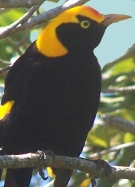
Birds of the Scenic Rim include:
- every
diurnal Australian raptor (kites,
eagles, hawks etc.) - many
live here, others (e.g. the endangered red
goshawk) are occasional
sightings
- the
uniquely
Australian lyrebirds,
arguably
the world's
best
mimics, and
the related rufous scrub bird
- birds
with unusual
courtship or
parenting such as lyrebirds,
bowerbirds
button-quail and
brush turkeys
- the world's only bird of Paradise south of the tropics
- some of Australia's largest birds - wedgetailed eagle, white-bellied sea-eagle, black-necked stork, magpie goose, pelican, black swan
Some National Parks (the most famous being Lamington National Park) have wonderful networks of accessible walking trails which provide great birding. Various creeks and large dams attract waterbirds, either residential or nomadic.
Birds
commonly
seen in the Scenic Rim:
Birds of eucalypt forests and woodlands:
Wedge-tailed eagle, pale-headed rosella, laughing kookaburra, sacred kingfisher, forest kingfisher, noisy miner, yellow-faced honeyeater, eastern spinebill, silvereye, Australian magpie, pied currawong, grey butcherbird, pied butcherbird, magpie lark, Torresian crow, variegated fair-wren, red-backed fairy-wren, willy wagtail, red-browed finch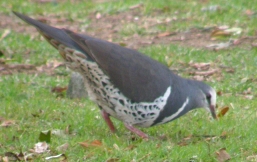
Birds
of
rainforests:
Crimson
rosella,
brown
cuckoodove, wompoo fruitdove, wonga pigeon (pictured),
brush
turkey, Lewin's
honeyeater, brown thornbill, brown gerygone,
white-browed scrubwren,
yellow-throated scrubwren, pied currawong, satin
bowerbird, green
catbirds, eastern whipbird, eastern yellow robinBirds of grassy areas:
Masked lapwing, black-shouldered kite, nankeen kestrel, Crested pigeon, Richard's pipitBirds of wetlands:
Ausralasian grebe, black duck, Wood duck, grey teal, black swan, little pied cormorant, little black cormorant, darter, Australian pelican, great egret, intermediate egret, cattle egret, white-faced heron, black-winged stilt, white ibis, straw-necked ibis, royal spoonbill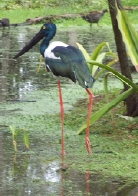 Rare and threatened birds of
the Scenic Rim include:
Rare and threatened birds of
the Scenic Rim include:
- Accipiter
novaehollandiae grey
goshawk Rare
- Erythrotriorchis radiatus red goshawk Endangered in Queensland, Vulnerable nationally
- Falco hypoleucos grey falcon Rare
- Lophoictinia isura square-tailed kite Rare
- Numenius madagascariensis eastern curlew Rare
- Lewinia pectoralis Lewin's rail Rare
- Ephippiorhynchus
asiaticus black-necked
stork (pictured on right)
Rare in
Queensland (and
not found in southern states, apart from far
north-eastern NSW)
- Nettapus coromandelianus common pygmy goose Rare
- Stictonetta naevosa freckled duck Rare
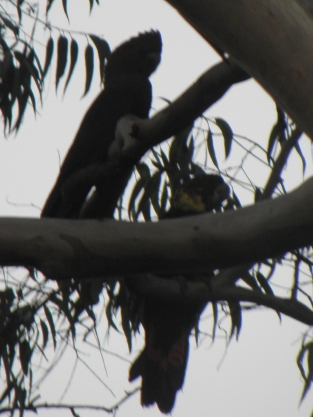
- Calyptorhynchus lathami glossy black-cockatoo Vulnerable
- Neophema pulchella turquoise parrot Rare
- Cyclopsitta diophthalma coxeni Coxen's figparrot Endangered
- Turnix melanogaster black-breasted button-quail Vulnerable
- Ninox strenua powerful owl Vulnerable in Queensland
 Tyto
tenebricosa tenebricosa sooty
owl Rare
Tyto
tenebricosa tenebricosa sooty
owl Rare- Podargus ocellatus plumiferus plumed frogmouth Vulnerable
- Menura alberti Albert's lyrebird Rare (and found nowhere other than the Qld/NSW border areas)
- Menura
novaehollandiae superb
lyrebird Rare
in Queensland
(also found in more southerly forests)
- Atrichornis rufescens rufous scrub bird Vulnerable
- Melithreptus
gularis black-chinned
honeyeater Rare
- Anthochaera phrygia regent honeyeater Endangered
- Grantiella picta painted honeyeater Rare
- Climacteris erythrops red-browed treecreeper Rare
- Dasyornis brachypterus eastern bristlebird Endangered
- Stipiturus malachurus southern emu-wren Vulnerable
- Pachycephala
olivacea olive
whistler Rare
See also: Australian birds
 Reptiles
 10
of the 17
families of native
Australian
reptiles are found within the Scenic
Rim - basically everything except crocodiles,
marine turtles and
sea-snakes .
10
of the 17
families of native
Australian
reptiles are found within the Scenic
Rim - basically everything except crocodiles,
marine turtles and
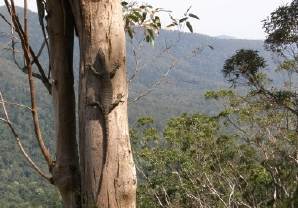
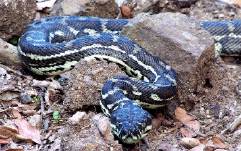
sea-snakes .Our largest snake is the (non-venomous) carpet python and our largest lizard is the lace monitor (goanna) - both are quite frequently encountered in warm months in rainforest, eucalypt forest and wooded farmland.
Reptiles in the Scenic Rim include:
- snakes:
- front-fanged snakes (elapids) - roughscale snake, eastern brown, taipan, red-bellied black snake, tiger snake, whip snakes, bandy bandy and others
- rear-fanged snaks (colubrids) - green treesnake, brown treesnake, keelback
- pythons - carpet python (pictured), children's python
- blind snakes
- lizards:
- monitors ("goannas", like the one pictured)
- skinks - many, including Australia's largest sking, the land mullet, also major skink, pink-tongued, blue-tongued, and many smaller species
- dragons - including bearded dragon, eastern water dragon and a few others
- geckos and flap-footed lizards
 turtles:
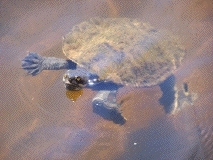
- long-necked, short-necked (pictured) and
saw-shelled
freshwater turtles
Rare and threatened reptiles of the Scenic Rim (the last four are skinks) include:
- Acanthophis antarcticus death adder Rare
- Coeranoscincus reticulatus three-toed snake-tooth skink Vulnerable
- Saproscincus rosei Rare
- Harrisoniascincus zia Rare
- Ophioscincus truncatus Rare
See also: Australian reptiles
Amphibians
Frogs
are the only amphibians native
to
Australia.
(We have no native toads, newts or salamanders)
Two families - Hylidae and Myobatrachidae - dominate most of Australia. Both are related to South American families (through a shared Gondwana heritage), and both of these are well-represented in the Scenic Rim . Three other families are found in far northern Australia, but not in this region.
Tree
frogs
(Hylidae).
Sedge frogs are common also - small green or brown frogs that call around dams and other still or slow-moving water, often sitting on waterlily leaves or on sedges and other vegetation above or near the water.
There are various small brown treefrogs - the most common being Litoria rubella and Litoria dentata - often seen climbing walls or posts on a warm wet evening.
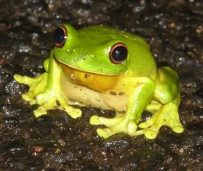 Orange-eyed green treefrogs
(photo
to right) can be heard on
a very wet summer evening in or near the rainforest,
with a series of
rising calls followed by an anticlimax of little noises
as the skin of
the throat deflates.
Orange-eyed green treefrogs
(photo
to right) can be heard on
a very wet summer evening in or near the rainforest,
with a series of
rising calls followed by an anticlimax of little noises
as the skin of
the throat deflates.
Emerald-spotted treefrogs are heard more often than seen, again most commonly near rainforests, with a distinctive 'machine-gun' call.
Rocket frogs (two species: striped and broad-palmed) have pointed noses, and use their strong legs to launch themselves impressively into the air. They are officially treefrogs but don't seem to do much climbing.
The stony-creek frog, which cam look very similar to the broad-palmed rocket frog, doesn't climb much either. In early spring the males develop bright yellow sides, and sit on rocks in the creek, calling to females.
Whistling treefrogs are one of the few frogs heard regularly in our creeks and dams throughout winter.
The striped burrowing frog (or green-striped frog) is in the same family as the treefrogs, but a different genus (Cyclorama) and not often seen, emerging mostly on warm very wet nights in some regions of open habitat, giving a distinctive 'quacking' call for several nights, then 'disappearing' again for months.
There are also a couple of rare and threatened treefrogs, plus a few other species in the region
Eggs of broodfrogs ('toadlets') are laid not in water but in small burrows in more open habitats.
The male tusked frog - another rainforest species - uses its small tusks to fight male rivals.
The most commonly-encountered frogs of this family are the marsh frogs - both striped and spotted - often heard calling around dams and swamps, and quite frequently seen on wet nights.
Pobblebonks - individually say 'bonk', different individuals varying slightly in pitch, and a chorus on a wet night sounds great.
Ornate burrowing frogs are often found by gardeners while digging - unfortunately they are sometimes mistaken for young cane toads (which never burrow).
There are also various small brown frogs not easily seen but often heard on warm wet evenings.
Brown frogs of all size, especially 'bumpy' ones, tend to get mistake for the introduced cane toads. Please never kill any unless you are VERY sure of your identification. We have a lot of native species of brown frogs around here.
One research program in Sydney University is trialling the provision of cane toad meat minced with a toxin that is not lethal but makes animals feel very ill, to train wild quolls not to eat them.
Driving at night along the country roads of the Scenic Rim you are almost certain to see cane toads except in mid-winter or very dry weather.
Please do NOT kill any large bumpy brown frog unless QUITE CERTAIN it is a cane toad, and don't kill ANY large tadpoles! Although toads grow larger than any of our native frogs, the tadpoles of the toads are NOT large - they are tiny, sharp-snouted, and black both on their backs and their bellies. They metamorphose into toads when still very small, so any large tadpoles are definitely natives. Frogs are very diverse in the Scenic Rim and include a number of brown ones, some with lumpy skin, and many are mistaken for young cane toads. If you do kill a cane toad (when certain of its identification) please do it swiftly and humanely - there are many inhumane methods used by people who are angry at the invasion, but it really wasn't the toad's idea to come here.
See also: Australian frogs
Two families - Hylidae and Myobatrachidae - dominate most of Australia. Both are related to South American families (through a shared Gondwana heritage), and both of these are well-represented in the Scenic Rim . Three other families are found in far northern Australia, but not in this region.
Tree
frogs
(Hylidae).
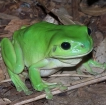
Green tree frogs (photo on left) are common in the Scenic Rim, sometimes appearing in toilets and laundries - anywhere nice and wet. They also like gutters, drainpipes, even hollow fence posts where their calls can resonate effectively (sounding a bit like . They're big enough to fit across the palm of an adult human hand (but please don't handle them unnecessarily - like all frogs their skin is very sensitive, and can absorb salt and other substances which may be damaging to them).
Sedge frogs are common also - small green or brown frogs that call around dams and other still or slow-moving water, often sitting on waterlily leaves or on sedges and other vegetation above or near the water.
There are various small brown treefrogs - the most common being Litoria rubella and Litoria dentata - often seen climbing walls or posts on a warm wet evening.
Orange-eyed green treefrogs
(photo
to right) can be heard on
a very wet summer evening in or near the rainforest,
with a series of
rising calls followed by an anticlimax of little noises
as the skin of
the throat deflates. Emerald-spotted treefrogs are heard more often than seen, again most commonly near rainforests, with a distinctive 'machine-gun' call.
Rocket frogs (two species: striped and broad-palmed) have pointed noses, and use their strong legs to launch themselves impressively into the air. They are officially treefrogs but don't seem to do much climbing.
The stony-creek frog, which cam look very similar to the broad-palmed rocket frog, doesn't climb much either. In early spring the males develop bright yellow sides, and sit on rocks in the creek, calling to females.
Whistling treefrogs are one of the few frogs heard regularly in our creeks and dams throughout winter.
The striped burrowing frog (or green-striped frog) is in the same family as the treefrogs, but a different genus (Cyclorama) and not often seen, emerging mostly on warm very wet nights in some regions of open habitat, giving a distinctive 'quacking' call for several nights, then 'disappearing' again for months.
There are also a couple of rare and threatened treefrogs, plus a few other species in the region
'Southern frogs' (Myobatrachidae)
Some of this family have bizarre breeding habitats. The female hip pocket (or pouched) frog of cool-temperate rainforests lays eggs on the ground, not in water. The male wallows in the jelly as the tadpoles hatch, and they wriggle into little 'pockets' of skin on his hips, where they stay until they develop into frogs.
Eggs of broodfrogs ('toadlets') are laid not in water but in small burrows in more open habitats.
The male tusked frog - another rainforest species - uses its small tusks to fight male rivals.
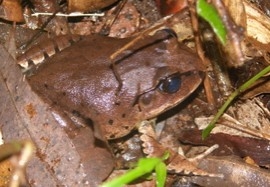
Great barred frogs (pictured) are often heard on wet nights, and sometimes during the day, mostly in and near rainforests: their deep-throated 'walk.... walk-walk' being quite unmistakable after you've heard it a couple of times. Its relatives, the giant barred frog and Fleay's barred frog, are far less common.
The most commonly-encountered frogs of this family are the marsh frogs - both striped and spotted - often heard calling around dams and swamps, and quite frequently seen on wet nights.
Pobblebonks - individually say 'bonk', different individuals varying slightly in pitch, and a chorus on a wet night sounds great.
Ornate burrowing frogs are often found by gardeners while digging - unfortunately they are sometimes mistaken for young cane toads (which never burrow).
There are also various small brown frogs not easily seen but often heard on warm wet evenings.
Brown frogs of all size, especially 'bumpy' ones, tend to get mistake for the introduced cane toads. Please never kill any unless you are VERY sure of your identification. We have a lot of native species of brown frogs around here.
Rare and threatened frogs in the Scenic Rim
Tree frogs
- Litoria revelata whirring treefrog Rare
- Litoria pearsoniana cascade treefrog Vulnerable
'Southern frogs'
- Adelotus brevis tusked frog Vulnerable
- Kyarranus loveridgei masked mountainfrog Rare (and confined to cool-temperate rainforests of high altitude in the Queensland - NSW border regions)
- Lechriodus fletcheri black-soled frog Rare
- Assa
darlingtoni
pouched
frog
(hip-pocket
frog)
Rare (and confined to
cool-temperate rainforests of high altitude in the
Queensland - NSW
border regions)
- Mixophyes iteratus giant barred frog Endangered
- Mixophyes fleayi Fleays frog Endangered
An introduced amphibian causing trouble
The cane toad (Bufo marinus) was regrettably introduced to Central Queensland in 1955, to control cane beetle (which it isn't very good at anyway) and has been spreading out from there ever since, to the detriment of our wildlife. It reached the Scenic Rim in the 70's or 80's, and is now very common (one female can lay over 30,000 eggs). Quolls, snakes, goannas, birds, fish (the eggs and tadpoles are poisonous also) and other wildlife (as well as pet dogs) have died after eating them, and some species have diminished alarmingly in numbers after cane toads move into a district. Here at Running Creek (south-eastern Scenic Rim) we have not seen red-bellied black snakes since the toads appeared in the late 80's, and although we are not certain of the connection we have seen far fewer tawny frogmouths in recent years (and we have heard of one frogmouth across the border found dead with a toad in its mouth). After their arrival in Northern Territory, rangers have reported a dramatic decline in quolls, and it seems likely that quolls and phascogales in the Scenic Rim have been affected also.
One research program in Sydney University is trialling the provision of cane toad meat minced with a toxin that is not lethal but makes animals feel very ill, to train wild quolls not to eat them.
Driving at night along the country roads of the Scenic Rim you are almost certain to see cane toads except in mid-winter or very dry weather.
Please do NOT kill any large bumpy brown frog unless QUITE CERTAIN it is a cane toad, and don't kill ANY large tadpoles! Although toads grow larger than any of our native frogs, the tadpoles of the toads are NOT large - they are tiny, sharp-snouted, and black both on their backs and their bellies. They metamorphose into toads when still very small, so any large tadpoles are definitely natives. Frogs are very diverse in the Scenic Rim and include a number of brown ones, some with lumpy skin, and many are mistaken for young cane toads. If you do kill a cane toad (when certain of its identification) please do it swiftly and humanely - there are many inhumane methods used by people who are angry at the invasion, but it really wasn't the toad's idea to come here.
See also: Australian frogs
Fish
 Some
of the fish of
the Scenic Rim include:
Some
of the fish of
the Scenic Rim include:- Long-finned eel (pictured) - these hatch from eggs
near New
Caledonia and have to head west to Australia, where
they spend 12 or
more years in rivers and streams of the east
coast, including the
high country of the Scenic Rim. They then have the
much more difficult
navigation feat of finding their way back to their
birthplace to
breed.
- Eel-tailed catfish - these can be large, up to about
90
centimetres long, but more typically 30 - 40cm.
In spring and
summer their circular stone nests are often seen in
mountain
streams. Better parents than most fish, the
parents guard the
eggs and hatchlings from predators. They occur in some
mountain streams
as well as further down in the valleys.
- Freshwater mullet - small schools of these fish can
often
be seen
in mountain streams and valleys, sometimes swimming
slowly just below
the surface with mouths open.
- Australian smelt - tiny fish that swim in schools and are useful in mosquito control. They are native to much of south-east Australia, including the Scenic rim, which is almost the northernmost part of their distribution. Groups of them will sometimes nibble gently at people swimming in the creeks and rivers of the region
- Mountain galaxias - small carnivorous fish of
south-eastern
Australia
- Crimson-spotted rainbowfish - small carnivorous fish
of
south-eastern Queensland and north-eastern New South
Wales
- Bony bream - a member of the herring family
- Fire-tail gudgeon - small carnivorous fish from
subtropical
Queensland. Males take on a red-orange colour in
breeding season.
- Cox's gudgeon - near the northern limit of its range
here,
mountain and alley streams
- Southern purple-spotted gudgeon - a small
carnivorous fish
whose
former range has been severely reduced, but still
present in some
creeks of southern Queensland and northern New South
Wales, including
those of the Scenic Rim
Invertebrates
 The
Scenic
Rim harbours some wonderful insects here, including some
of Australia's
largest butterflies and a gnat that produces very
efficient light now
used in cancer research and Japanese Christmas trees,
also some giant
(but not dangerous) spiders, bright blue crayfish, large
ridiculously
pink slugs and many, many more fascinating
invertebrates.
The
Scenic
Rim harbours some wonderful insects here, including some
of Australia's
largest butterflies and a gnat that produces very
efficient light now
used in cancer research and Japanese Christmas trees,
also some giant
(but not dangerous) spiders, bright blue crayfish, large
ridiculously
pink slugs and many, many more fascinating
invertebrates.A small sample of insects of the Scenic Rim:
Glow worms are not worms but a kind of fungus gnat, related to flies and mosquitoes. It is in their larval stage that they produce light to attract small insects which they then eat. They live in moist rocky overhangs, shallow caves and creek banks in Lamington National Park and other suitable habitat within the Scenic Rim. They are also breeding prolifically in a well-designed artificial cave at the Cedar Creek Estate on Tamborine Mountain. As a group. the true glow worms are found only in Australia and New Zealand. Their efficient light production (very little is lost as heat) is being studied and used in cancer research, and in Japan to grow genetically-modified self-lighting Christmas trees.Butterflies are numerous, with Australia's five major families represented. A small sample:
- Pieridae:
e.g.
- the
highly social and migratory caper white (pictured
above),
- common grass yellow, pollinator of many low-growing flowers including the arrow-head violet so crucial for the fritillary
- Nymphalidae:
e.g.
- the highly-endangered fritillary, the only known foodplant being the arrow-head violet which itself is far more restricted in range than it once was.
- lesser wanderer (a bit smaller than the introduced monarch (the latter is also known as the wanderer)
- blue tiger ) a bit like a blue version of the wanderer, sometimes in large groups)
- common brown
- common crow
- painted lady
- evening brown (flutters close to the ground and drops, looking like a dead leaf when it closes its wings)
- Lycaenidae
- long-tailed
pea-blue
-
a
common
small butterfly, the larvae of which feed on buds
and flowers of legumes
- common
grass-blue (Australian subspecies) - a very common
little butterfly
that darts amongst grasses to lay eggs on legumes
- copper
ant-blue and bronze ant-blue -
as in various other
members of this family, they appear to have an
association with ants
- moonlight
jewel
(eastern
subspecies)
- Papillionidae
- Richmond birdwing butterfly - one of Australia's largest and most attractive butterflies, rare and considered vulnerable nowadays, dependent on a native vine which in turn is dependent on a small pollinating gnat, which in turn is itself dependent on clear mountain streams for its larval stage
- Orchard butterfly - another of Australia's largest butterflies, almost as big as the birdwing and far more common
- blue
triangle - beautiful turquoise blue butterfly
- Hesperidae
- regent
skipper - one of the most attractive skippers,
mostly black with white
markings and a bold scarlet end to its abdomen
Spiders of the Scenic Rim
We have the two most infamous Australian spiders here - the funnel-web and the redback, but there have been less than 30 recorded deaths by spiders in all of white settlement (and none from the redback since the 1950's). Both spiders are easily avoided, so there is no need to be fearful if you just check what might be lurking in dark corners before sitting down, reaching into sacks, or putting on old gloves or boots etc.Many of our spiders are really quite beautiful and have fascinating behaviours, and most are not at all dangerous (although some are capable of a painful bite)
Other spiders - a small sample once again:
'Primitive spiders' (their most conspicuous difference from 'true spiders' is that their jaws point downwards, so they rear up and strike downwards when attacking)
- Funnel-web spiders
- Trapdoor spiders - related to funnel-webs, but no fatalities recorded
- Leaf-curl spider - they come down to the ground at
night to
find
a suitable leaf which they curl up and secure in the
web, and hide
inside from birds
- Golden orb-weaver - these build large strong webs
that
reflect
golden light in the sunlight. The spiders themselves
are large but not
dangerous to humans
- St Andrew's Cross spider - an attractive spider
that sits
in its
web with four pairs of legs arranged in a 'X' like
the St Andrews Cross
which forms part of the Union Jack. A zigzag pattern
of web extending
from each pair of legs accentuates the 'X' shape.
- Wolf spiders - these don;t build webs but
typically sit on
the
ground at night waiting for prey they can ambush or
chase - their eyes
brightly reflect light when torches
(flashlights) are shone
towards them.
- Huntsman spiders - another spider which does now
build
webs. These are large spiders and some species
readily enter
houses, where they can provide a service controlling
insects.
- Jumping spiders - active, alert-looking little
spiders,
that do
actually jump. The males of each species have
their own courtship
dances to attract females.
Crustaceans of the Scenic Rim
- Lamington
Cray - a blue freshwater crayfish of mountain
streams in the
rainforests of Lamington National Park (a similar
species is found in
the same kind of habitat just below the border, but
red and white
rather than blue). Sometimes they are out on the
walking tracks,
raising their pincers and hissing at walkers,
rotating to keep facing
them as they edge around the agitated crustaceans in
a semicircle to
continue their journeys.
- Macrobranchia -
a small shrimp with
one long arm, and eyes that glow red in the light of
a torch
(flashlight) at night.
- Land
crustaceans - amphipods (small creatures that jump
around actively if
their leaf litter home on the forest floor is
disturbed) and isopods
(slaters, often living in small groups under rocks
or logs
Molluscs of the Scenic Rim
- We have one of the highest diversities of Gondwana-related land snails in Australia, and also of have a number snails and slugs descended from northern hemisphere ancestors, including some quite large ones in the rainforest, sometimes seen at night feeding on luminous fungi.
- Various freshwater snails live here also.
- Freshwater mussels and other bivalves live in some creeks and dams
- Triangle
slugs live under leaf litter and on moist evenings
climb eucalypts
leaving distinctive markings on the trunks as they
browse. One species
on Mt French can grow to 7 cm, and is bright pink.
 Plants
The Scenic Rim
is home to
a wonderful diversity of plant life - one
of the highest
in Australia.
Vegetation includes several kinds of rainforest (warm subtropical, as well as other forest and woodland types, heaths and wetlands.
Moraceae
-
figs and their relatives
Figs
are a
very
important source of food for frugivores (fruit-eating
animals), here as
in other warm regions of the world, and
as for figs
everywhere are dependent on tiny fig-wasps for
pollination. Here they are
mostly eaten by birds and fruitbats (which help to
distribute seeds,
except for some birds that digest the seeds with the
fruit) and
insects, but also by some possums, wallabies and other
creatures. We
have several species in the Scenic Rim including the
Moreton Bay fig (Ficus
macrophylla), a large species
used for street-planting and parks throughout Australia.
Figs are
primarily rainforest species, but some, such as the
creek sandpaper fig
(Ficus coronata),
are common
along creeks emanating from the rainforests.
Myrtaceae
-
eucalypts
and lillypillies
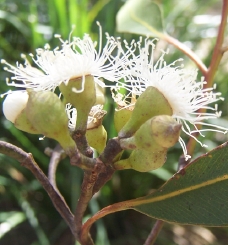 Some are
fleshy-fruited (as are the related guavas of South
America), others are
dry-fruited with small seeds, an adaptation that arose
as Australia's
climate was drying out.
Some are
fleshy-fruited (as are the related guavas of South
America), others are
dry-fruited with small seeds, an adaptation that arose
as Australia's
climate was drying out.
Nothofagus
moorei, the Antarctic beech, reaches its
northern limit here on
some of
our highest peaks, both in Lamington National Park and
the more
sheltered parts of Mt Barney.
They are the dominant tree in the cool temperate rainforest, and have a strange, Tolkien-like appearance, usually with several stems coming from the same rootstock, and plenty of moss growing on the lower trunk.
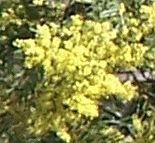
Acacia species
are generally known as 'wattles' in Australia, and most
do not keep
their true leaves but photosynthesize instead with a
modified petiole
known as a phyllode. All have fluffy clusters of flowers
ranging from a
creamy pale yellow to a rich golden yellow. A few of the
local species
do keep their true leaves. Most are plants of the
open forest,
and most live only about 10 - 15 years, but the
blackwood, Acacia
melanoxylon,
is a long-lived rainforest inhabitant.
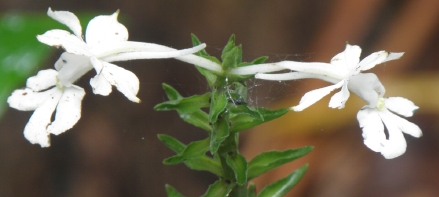 The Scenic
Rim
is home to many orchids, both epiphytic (growing on
trunks or branches
of trees ) and ground-dwelling. A very few
examples are:
The Scenic
Rim
is home to many orchids, both epiphytic (growing on
trunks or branches
of trees ) and ground-dwelling. A very few
examples are:
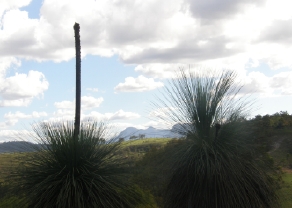
Grass trees - Xanthorrhoea spp. These give a very distinctive, Australian feel to any landscape, and their flower spikes produce myriads of nectar-rich flowers attracting many birds, butterflies and native bees (photo left)
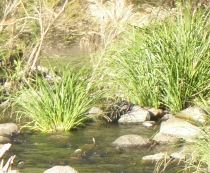
Mat rushes - Lomandra spp- common along creeks, and can hold often onto their roots and soil better than the surrounding trees during a severe flood, so are recommended for planting along banks in flood-prone areas (photo right)
Vegetation includes several kinds of rainforest (warm subtropical, as well as other forest and woodland types, heaths and wetlands.
Just a few of the local plant families include:
Moraceae
-
figs and their relatives
Figs
are a
very
important source of food for frugivores (fruit-eating
animals), here as
in other warm regions of the world, and
as for figs
everywhere are dependent on tiny fig-wasps for
pollination. Here they are
mostly eaten by birds and fruitbats (which help to
distribute seeds,
except for some birds that digest the seeds with the
fruit) and
insects, but also by some possums, wallabies and other
creatures. We
have several species in the Scenic Rim including the
Moreton Bay fig (Ficus
macrophylla), a large species
used for street-planting and parks throughout Australia.
Figs are
primarily rainforest species, but some, such as the
creek sandpaper fig
(Ficus coronata),
are common
along creeks emanating from the rainforests.Myrtaceae
-
eucalypts
and lillypillies
Some are
fleshy-fruited (as are the related guavas of South
America), others are
dry-fruited with small seeds, an adaptation that arose
as Australia's
climate was drying out.- Lillipillies - Syzygium and Acmena species - are the main fleshy-fruited members in Australia, with numerous species in the Scenic Rim
- Various other fleshy-fruited members
- Eucalyptus
- numerous species
in the Scenic Rim, including forest red or
Queensland blue gum (Eucalyptus tereticornis) which is
a
favourite of koalas, flooded gum (E.
grandis) which grows tall and straight on
good soils near
rainforests, many others
- Close relatives of eucalypts - Corymbia (bloodwoods, spotted gums, tesselated gum), apple gums (Angophora spp), brushboxes (Lophostemon) and water gum (Tristaniopsis)
- Other
dry-fruited members - including bottlebrushes
(formerly Callistemon,
now Melaleuca),
tea-trees (Melaleuca
and Leptospermum)
Lauraceae
Avocado family (no avocados native here, but plenty of their smaller relatives in the rainforests, popular with fruitpigeons, not so much with fruitbats)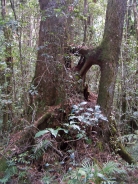 Fagaceae
Nothofagus
moorei, the Antarctic beech, reaches its
northern limit here on
some of
our highest peaks, both in Lamington National Park and
the more
sheltered parts of Mt Barney.They are the dominant tree in the cool temperate rainforest, and have a strange, Tolkien-like appearance, usually with several stems coming from the same rootstock, and plenty of moss growing on the lower trunk.
Mimosaceae
Orchidaceae
The Scenic
Rim
is home to many orchids, both epiphytic (growing on
trunks or branches
of trees ) and ground-dwelling. A very few
examples are:- Christmas orchid (Calanthe
triplicata) - a ground-dwelling orchid with a
large spray of
white flowers around Christmas time.
- King orchid Dendrobium tarberi - a fairly common epiphyte with large leaves and a showy cascade of yellow flowers
- Hoop Pine Orchid Bulbophyllum globuliforme - a tiny orchid growing on the bark of hoop pines in high altitudes of the McPherson Range, considered vulnerable, and not readily seen as it grows in the upper branches and trunk
- Beech orchid (Dendrobium falcorostrum) - epiphytic on Antarctic beech trees of the cool temperate rainforest in high altitudes
- Many others
Xanthorrhoeaceae
Grass trees - Xanthorrhoea spp. These give a very distinctive, Australian feel to any landscape, and their flower spikes produce myriads of nectar-rich flowers attracting many birds, butterflies and native bees (photo left)
Mat rushes - Lomandra spp- common along creeks, and can hold often onto their roots and soil better than the surrounding trees during a severe flood, so are recommended for planting along banks in flood-prone areas (photo right)