 |
|||||||||||||||
|
|||||||||||||||
|
|
|||||||||||||||
What is so different about Australia?

 Well, for starters:
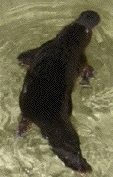
- it is the only continent to still have all three of the major groups of mammals: monotremes (egg-layers), marsupials and placentals
- half its mammal species are marsupials
- its
large
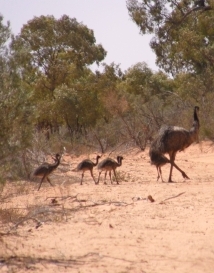
grazing animals are all marsupials or birds, mostly
moving on two legs
(kangaroos, emus)
- it is the only country in the world to have kangaroos (although it shares wallabies with New Guinea), koalas, wombats numbats, platypus, lyrebirds and many other strange and fascinating creatures
- most
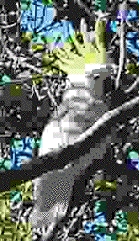
of the world's cockatoos are native to Australia,
and it has more
parrots than any continent other than South America
- Glow
worms
(larvae of a tiny gnat, living in caves and
overhanging rocks - not
the same as the
'glow worm' of the northern
hemisphere, which is the larva of the firefly) live
only in Australia
and New Zealand.
 it
is the
only continent other than Antarctica to NOT have
native hoofed animals,
or native terrestrial Carnivora (dogs, bears, cats,
weasels etc., but
we do have seals and sea lions) - the dingo
appears to have arrived from South-east Asia only
about 4,000 years ago,
probably with Indonesian traders
it
is the
only continent other than Antarctica to NOT have
native hoofed animals,
or native terrestrial Carnivora (dogs, bears, cats,
weasels etc., but
we do have seals and sea lions) - the dingo
appears to have arrived from South-east Asia only
about 4,000 years ago,
probably with Indonesian traders- it is probably the birthplace of the world's songbirds, and shares with New Zealand some songbirds with primitive characteristics
- lyrebirds, arguably the world's best mimics, occur only here
- some of our frogs have bizarre breeding habits - e.g. the gastric brooding frog (now apparently extinct) and the hip pocket frog
- we
have
most of the world's ten most venomous snakes (in
terms of toxins
applied to mice) but not necessarily the most
dangerous (which is a
function also of behaviour and habitats of snakes)
Evolutionary/biogeographical history of Australia
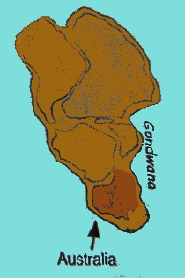 Australia
was
once part of the great southern super-continent Gondwana
(which included what
we now know as South America, Africa,
Madagascar and India as well as many of what are now
smaller islands). India broke away
and other parts gradually did likewise
Australia
was
once part of the great southern super-continent Gondwana
(which included what
we now know as South America, Africa,
Madagascar and India as well as many of what are now
smaller islands). India broke away
and other parts gradually did likewiseAbout 50 million years ago Australia and New Guinea jointly drifted away from Antarctica,. This was the final major break-up of the huge southern continent.
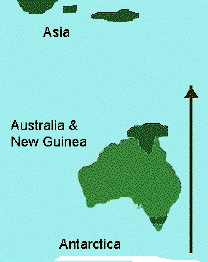 Australia
broke
away before any hoofed animals, cats, bears, monkeys,
rodents or other
placental mammals reached it, but did have
monotremes (egg-laying mammals) and marsupials (mammals
whose young are
born at a very immature stage and attach firmly to a
teat inside a
pouch or between protective flaps of skin for the next
few weeks). As
it
drifted northwards, Australia was isolated from other
continents for
many millions of years. Bats and sea mammals soon
reached it - others
had to wait until it got close to Asia.
Australia
broke
away before any hoofed animals, cats, bears, monkeys,
rodents or other
placental mammals reached it, but did have
monotremes (egg-laying mammals) and marsupials (mammals
whose young are
born at a very immature stage and attach firmly to a
teat inside a
pouch or between protective flaps of skin for the next
few weeks). As
it
drifted northwards, Australia was isolated from other
continents for
many millions of years. Bats and sea mammals soon
reached it - others
had to wait until it got close to Asia.Thus its fauna and flora include many species whose ancestors were in Gondwana, some of which, like the emus, freshwater turtles, tree frogs and land snails, still somewhat resemble their cousins in South America, which had also remained attached to Antarctica for a long time (in the days when Antarctica still had forests).
Others, like the kangaroos, platypus and lyrebirds, are remarkably different from animals on any other continent.
Also see:
Evolutionary history of freshwater fishes and crustaceans of south-east Australia: conservation, genetics, and geology
Phylogenetic Systematics and Bioinformatics, Australian National University (reptiles, invertebrates, plants)
Geological History and Australian Flora
Australia's oldest amphibians
Fish (or go to mammals, birds, reptiles,
frogs or invertebrates)
 Fish are vertebrates
that
live their entire lives in water, breathe through
gills and don’t go through the kind of dramatic
life-change that
amphibians do (although some, like the lungfish, have
developed ways of
occasionally breathing in air).
Fish are vertebrates
that
live their entire lives in water, breathe through
gills and don’t go through the kind of dramatic
life-change that
amphibians do (although some, like the lungfish, have
developed ways of
occasionally breathing in air).Australia’s freshwater fish have all evolved relatively recently from marine ancestors – we don’t have the families common in other continents with a long evolutionary history of freshwater life.
No attempt will be made here to cover the tremendous diversity of fish, just a few points of interest here:
- The Australian lungfish, a freshwater species capable of breathing in air, is considered a ‘living fossil’ and is found in some of Queensland’s rivers. Only five other species occur worldwide, all in Africa and South American waters. It is strictly protected.
- The eels (photo top right) in Australian rivers start their lives near New Caledonia and other part of the south-west Pacific, make a journey to Australia where they live for 12 years or more in the rivers of the east coast, then find their way back to their birthplace to breed. There are usually at least a couple resident on the Araucaria property.
- The world’s largest fish, the whale-shark, visits the western coast each year. Carefully-controlled diving near these huge creatures (which feed only on plankton) is a popular tourist activity at Ningaloo.
 The
world-famous
Great Barrier Reef harbours a vast and fascinating
diversity of fish,
some of which featured in the popular animation film
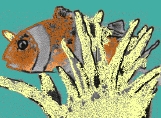
‘Finding Nemo.’
The
world-famous
Great Barrier Reef harbours a vast and fascinating
diversity of fish,
some of which featured in the popular animation film
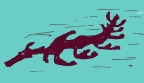
‘Finding Nemo.’- The strange leafy sea-dragon, related to sea-horses, can sometimes be seen by divers near Kangaroo Island and other parts of the southern coastline.
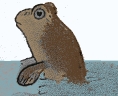
- The
mud skipper, seen amongst mangrove roots (and
climbing them!) north of
Cairns, comes out of the water and stares at you!
Further information on fish:
Freshwater fish
Australian freshwater
fish have all evolved relatively recently from marine
ones - we have
none of the ancient lineages of freshwater fish
families that other
continents have
A very good source of information on our freshwater fish, their ecology, behaviour and conservation, is Native Fish Australia
A very good source of information on our freshwater fish, their ecology, behaviour and conservation, is Native Fish Australia
Marine fish
We have a wonderful
diversity of marine fish, from the strange leafy sea
dragon of South
Australian coasts, through the myriads of coral reef
fish to the
biggest fish in the world, the whale-shark
Sites with good information on reef fish include CRC Reef and Ocean Light, a large site with many photos of reef fish,
Sites with good information on reef fish include CRC Reef and Ocean Light, a large site with many photos of reef fish,
Invertebrates
More details will be added to this page in the future
Meantime see:
Bugwise
(Australian Invertebrates)
Arachnids (book about spiders, ticks and kin)
Arachnids (book about spiders, ticks and kin)
Insects - coming soon!
A useful compact reference is: Zbrowksi, P. and Storey, R. (1995). A Field Guide to Insects of Australia. Reed Books, Kew (an amazing amount of detail packed into a compact paperback book)
CSIRO produces two massive (and expensive!) volumes for the identification of Australian insects
There are also various useful guides to Australian dragonflies, butterflies, moths, ants, stick insects (phasmids) and other insects)
e.g.
Common, I. F. B. and
Waterhouse, D. F. (1981). Butterflies of
Australia. Angus and Robertson, London
The Complete Field Guide to Dragonflies of Australia
Moths of Australia
The Complete Field Guide to Dragonflies of Australia
Moths of Australia
Spiders
Australian
spiders
include
the
'true'
spiders and the 'primitive' spiders.
 The
'primitive
spiders
have
jaws
which point downwards, meaning that to
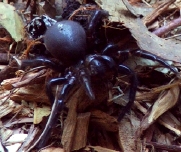
bite they need to rear up and strike downwards.
Australia's most
dangerous spiders, the funnel webs, are in this group,
and also the
trapdoors. To keep the danger in perspective though,
there have only
been 14 recorded deaths by funnel webs in the history
of white
settlement. Most of these have occurred in
Sydney, where funnels
are sometimes built in gardens and inadvertently
disturbed.
The
'primitive
spiders
have
jaws
which point downwards, meaning that to
bite they need to rear up and strike downwards.
Australia's most
dangerous spiders, the funnel webs, are in this group,
and also the
trapdoors. To keep the danger in perspective though,
there have only
been 14 recorded deaths by funnel webs in the history
of white
settlement. Most of these have occurred in
Sydney, where funnels
are sometimes built in gardens and inadvertently
disturbed.
The
'true'
spiders include all the others, including the infamous
redback
(probably a form of black widow, responsible for a
similar number of
deaths but none since the introduction of antivenin in
the 1950's),
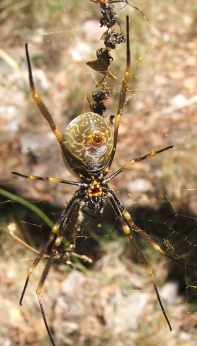
the large and impressive golden orb weavers, the
huntsman and wolf
spiders that chase their prey instead of snaring it, and
many others,
some quite beautifully coloured. The vast majority are
never dangerous,
but some can give a painful nip.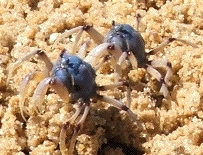 Other invertebrates
include:
Other invertebrates
include:
* Sea-stars, sea-urchins and sea-cucumbers
* Molluscs - snails, slugs,cowries, oysters, clams, octopus ...
* Earthworms and leeches
* Flatworms - not related to earthworms (they're just called worms because they're long and thin and lack legs)
* Jellyfish, anemones and corals
* Sponges
* Various other groups of small creatures
back
to top of page
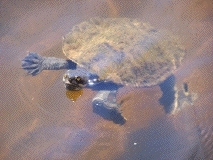
Vertebrates (like
the turtle on the
right, and the koala above) are animals with a chord
of nerve tissue running from the brain down the centre
of their backs
protected by a series of small bones (or cartilage in
some of the more
'primitive' fish such as sharks and rays) known as
vertebrae. This
column of bones is often called a 'vertebral column',
a 'backbone', or
a 'spine'. All vertebrates also have skull and ribs,
and apart from
fish most have four limbs (either four legs, two wings
and two legs, or
two arms and two legs).
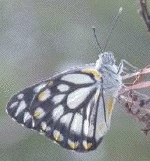
Invertebrates (like the butterfly pictured) do not have vertebrae, and their nervous systems often follow a somewhat different pattern. The largest group of invertebrates are the arthropods, including insects, spiders, crustaceans and others with an external skeleton (exoskeleton), a tough skin which supports and holds the softer body parts in place in much the same way that the internal skeleton of vertebrates does for theirs. Other invertebrates are molluscs (which often have hard eternal shells but not jointed limbs), various 'worms' (which include several distinctly different and unrelated groups), anemones, sea-stars and various other groups.
back to top of page
 What
do
the
words
'vertebrate'
and
'invertebrate' mean?
What
do
the
words
'vertebrate'
and
'invertebrate' mean?
Vertebrates (like
the turtle on the
right, and the koala above) are animals with a chord
of nerve tissue running from the brain down the centre
of their backs
protected by a series of small bones (or cartilage in
some of the more
'primitive' fish such as sharks and rays) known as
vertebrae. This
column of bones is often called a 'vertebral column',
a 'backbone', or
a 'spine'. All vertebrates also have skull and ribs,
and apart from
fish most have four limbs (either four legs, two wings
and two legs, or
two arms and two legs).Invertebrates (like the butterfly pictured) do not have vertebrae, and their nervous systems often follow a somewhat different pattern. The largest group of invertebrates are the arthropods, including insects, spiders, crustaceans and others with an external skeleton (exoskeleton), a tough skin which supports and holds the softer body parts in place in much the same way that the internal skeleton of vertebrates does for theirs. Other invertebrates are molluscs (which often have hard eternal shells but not jointed limbs), various 'worms' (which include several distinctly different and unrelated groups), anemones, sea-stars and various other groups.
back to top of page