 |
||||||||||||||||
|
||||||||||||||||
Birds
of
Australia
|
|
|||||||||||||||
There are so many species in Australia we cannot do justice to them here, but here is a sample, with links to further information |
||||||||||||||||
 General
information on Australian birds
General
information on Australian birds
What is a bird?
Australia's biggest birds
Birds with unusual courtship or nesting behaviour
Birds that landscape our countryside
Birds of bright colours or 'odd' appearance
Birds with unusual voices
Families unique to Australia or to Australia and New Guinea
Families found from Australia through Asia to Africa but not Europe or the Americas
Threatened species
The flightless ones - emus and cassowaries
Water-birds - black swans, ducks, storks, cranes, waders, gallinules and others
Marine birds
Migrants and nomads
 Samples
of
bird families and species
Samples
of
bird families and species
Cockatoos and parrots
Cuckoos - none say 'cuckoo' but they do lay eggs in other birds' nest (except one)
Megapodes - males build large mounds in which the eggs are incubated
Pigeons - bright-coloured fruit-eaters, many seed-eaters.
Frog-mouths (camouflaged as a piece of branch) and nightjars
Birds of prey - day and night
Kookaburras and other kingfishers
Songbirds - evidence for an Australian ancestry
Lyrebirds - world's best mimics (and great dancers too)
Honeyeaters - the largest songbird family in Australia, many and varied species
Australian 'magpies' and their relatives
The magpie lark and monarchs - who would think they are related?
Apostle birds and choughs - endemic mud nest builders
Fairy wrens - small flashes of colour in the bush
Shrike-thrushes and whistlers - songsters bright and drab
The 'robins' - red-breasted, yellow-breasted and plain (none are actually robins)
Bowerbirds - incredible artists of the bird world
Birds of Paradise - most are in New Guinea, but Australia has four species
And the rest ....
What is a bird?
 From
ducks to eagles, from
emus to finches, from frogmouths to penguins, birds
comprise a
marvellous assortment of creatures, but they
all have some
features in common.
From
ducks to eagles, from
emus to finches, from frogmouths to penguins, birds
comprise a
marvellous assortment of creatures, but they
all have some
features in common.A bird is a vertebrate animal that shares the following features with other vertebrates:
- all vertebrates - nerve chord extending from the brain down the back, surrounded by segmented bone or cartilage (includes, fish, amphibians, reptiles, birds and mammals), and relatively large brain compared to other animal groups
- similar
to
most vertebrates other than fish in having four
limbs - but different
from most in walking on the hind limbs, the
forelimbs modified into
wings
- similar to most fish, amphibians and reptiles in laying eggs - although some fish and some reptiles do not do so, ALL species of birds reproduce by eggs
- similar to mammals, reptiles and adult amphibians in breathing with lungs
- similar to mammals in their ability to regulate body temperature (including brain temperature, which is a major reason birds and mammals tend to be the most 'intelligent' of animals - however 'intelligence' is defined)
They
differ from all
other animals in having feathers.
All walk on hind legs(although some, like swifts, do very little walking)
No present day birds have teeth, but some prehistoric birds such as Archaeopteryx did
style="font-family: Helvetica,Arial,sans-serif;">
Some of the main dispersers in the rainforests are fruitdoves, bowerbirds, catbirds, lewin's honeyeaters, pied currawongs and cassowaries, also figbirds, which tend to visit edges of rainforests rather than penetrate deeply into them. Many others disperse seeds at least occasionally.
In more open habitats, emus, mistletoebirds, crows and many honeyeaters disperse seeds, with many other species (cuckoos, cuckooshrikes, orioles, butcherbirds, others) doing so at least occasionally.
The yellow and red pigments of the fruit is often transferred to the feathers of the bird that eats it.
Before a flowering plant (whether it's a tree, shrub, vine or herb) sets seeds, its flower must be pollinated. Many are pollinated by wind or by insects, but nectar-feeding birds such as honeyeaters and some parrots alps play an important roles. Bird-pollinated flowers tend to be fairly robust, to withstand vigorous feeding activities, and are often red, pink or creamy-white, with plenty of nectar and easily-dislodged pollen.
 Crested
birds:
Crested
birds:
Other unusual appearance:
Families
unique to
Australia or to Australia and New Guinea
Coxen's figparrot. This small parrot used to depend on the abundance of fruiting figs in lowland rainforests during the winter months. Now most of the lowland rainforest has been cleared, and the Coxen's figparrot (a subspecies of the double-eyed parrot) is now rarely seen and probably only a few dozen individuals remain, if that.
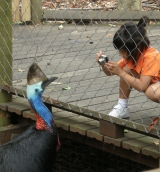
Cassowary. In patches of rainforest remnants that have lost the cassowary, there is a severe reduction in seed dispersal of plants with large fruits, although fruitbats, rodents or the musky rat kangaroo may carry some of them a short distance .
Many others - see Birds Australia's Threatened Bird network and the Australian government's list of threatened bird species
There used to be two other species on southern islands, but they were driven to extinction by hunting.
Cockatoos are essentially parrots with crests (and gall bladders)
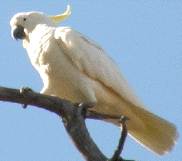
Most of the world's cockatoos are Australian, with a few species in New Guinea and southeast Asian islands. They all have crests, ranging from the small crests of cockateils, galahs and corellas to the spectacular ones of major mitchells and palm cockatoos.
Wikipedia has a good cockatoo page
Rosellas
Rosellas are a purely Australian group of colourful parrots with long tails and a pattern of little black scallops on their backs.
Lorikeets
These bright green or multi-coloured little parrots feed mostly on nectar and pollen
Budgerigars
One of the world's most popular pet birds, they still live and breed in in large flocks in Australia's outback
Other parrots
There are many pother parrots in Australia, from the small and critically-endangered Coxen's figparrot to the large and colurful king parrots.
None of our cuckoos say anything remotely resembling "cuckoo." One gives a loud prolonged squawk (channel-billed cuckoo), one a kind of 'cooee' call (koel), one a downwards trill (fantailed cuckoo), another a series of rather frantic calls as though the bird is heading for a nervous breakdown (brush cuckoo), and others give various kinds of whistling calls. The only bird that actually sounds like a European cuckoo is an owl, the boobook owl.
Different sizes of cuckoo naturally choose nests of different sized birds to lay their eggs in. The big channel-billed cuckoo for instance lays its eggs in the nests of crows and similar-sized birds, while small cuckoos lay in the nests of small birds: the young cuckoo may still be quite a lot larger than the nestlings of the host bird.
Probably the best-known megapode in Australia is the brush turkey, easily seen in rainforest areas and sometimes entering the suburbs of Brisbane (not always welcomed by home-owners, who may for instance find all the pine chips from their garden scratched into a mound against their garage door)
Find information here on the malleefowl, of dry open country in southern Australia (the world's only megapode to NOT live in dense forest)
The smallest species in Australia, the orange-footed scrubfowl, builds an impressive mound up to several metres in diameter.
You can see a list of the world's megapodes, with links to photos, videos and calls, here.
See also a good book on the megapodes by Darryl Jones, who studied the brush turkeys some years ago for his PhD, and two co-authors.
style="font-family: Helvetica,Arial,sans-serif;">Most pigeons, like pigeons the world over, digest the seeds they swallow. One of the best--known is the crested pigeon, fund in most open habitats over much of Australia.
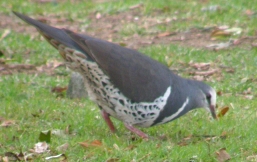
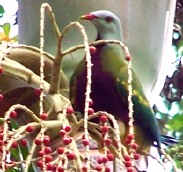
Pictured here are the wonga pigeon (left) and the wompoo fruitdove (right)
Eagles include the wedge-tailed eagle (largest species), white-bellied sea-eagle and little eagle
Kites include the brahminy (beautiful white and red-brown plumage, hunts fish along coasts), whistling (big enough and similar enough wing pattern to be mistaken for little eagle, but with distinctive call), black (very common in outback), black-winged (often seen hovering), letter-winged (often hunts at night, although technically one of the diurnal raptors),
Others include black-breasted buzzard (which is not actually a buzzard), osprey (same species as in northern hemisphere), several goshawks, two harriers, a sparrowhawk, a baza, several falcons (including the Peregrine falcon found also in other continents) and a kestrel (essentially a small falcon, but kestrels hover more than other falcons).
Boobook - an owl whose call is often mistaken for something else. The boobook owl gives the 'mopoke' call, one of the most familiar sounds of the Australian bush at night (and the closest sound to a European cuckoo call that you will hear in Australia). Many people are convinced it is the tawny frogmouth, but this is incorrect. The boobook is often heard but not seen, while the frogmouth is often seen and not heard, in the same patch of forest. Others in the past have insisted the 'mopoke' call comes from the echidna, the goanna, or even the carpet snake, presumably because they have gone outside to investigate the source of the call, found one of these creatures and not seen the mottled brown owl sitting quietly on a branch close to the trunk of a tree.
Powerful owl - our largest owl, with a wingspan of about 1.3metres, and feeds mainly on arboreal mammals and roosting birds.
Barking owl - it usually sounds like a small dog barking, but every now and then gives a blood-curdling scream which has earned it the nickname of 'mad woman owl.' I'm told that if you hear in in the middle of the night while camping it makes all the hairs on the back of your neck stand up.
There are various other owls, including the barn owl (Tyto alba) which is found throughout Australia, and on all continents except Antarctica, and some rarer relatives, such as two species of sooty owl (their calls at night sound a bit like a bomb falling but never landing).
Tawny frogmouths (the common species, found throughout most of Australia) definitely do NOT, EVER make a 'mopoke' call, despite Banjo Patterson's poem and the adamant protests of many who still believe they do. They instead makes a repetitive call - 'oom-oom-oom' which in its most rapid form sounds like some kind of machinery starting up, plus a few low 'growling' noises.
During the day, frogmouths sit on a branch at an angle, and are perfectly camouflaged to blend in and look like a short projection of broken branch. It is easy to walk right past one without noticing it.
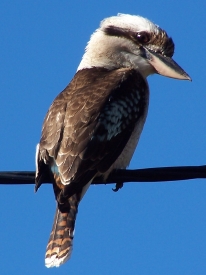
The best-known species is the laughing kookaburra, with its rollicking laughter. The other is the blue-winged kookaburra of the northern half of Australia, which has a strange call sounding like it's trying to laugh and not quite getting it right. Both species have blue on their wings, but the blue-winged kookaburra has the largest patch.
The beautiful little azure kingfisher, with bright blue above and bright red on the breast, does feed on fish, and sometimes follows the platypus in the hope that it will disturb fish that it can then more readily detect and catch.
Strange that a suboscine would be such an accomplished songster.
There are only two species in the world, both confined to Australia - the superb lyrebird of eastern forests (to as far north as southern Queensland) and the Albert's lyrebird (subtropical forests of Qld/NSW border regions)
David Attenborough's 'Life of Birds' shows a lyrebird mimicking the sounds of camera shutter releases and motor drives
You can also hear lyrebirds and read about one research program here
They do not eat only nectar - all eat insects as well for protein, and some also eat fruits. Those that include the larger proportions of nectar in their diets tend to have longer bills than those with a higher proportion of insects in their diets. Many are important pollinators of plants, especially in the Myrtaceae (eucalypts, bottlebrushes), Proteaceae (banksias, grevilleas) and Epacridaceae (heathy shrubs) families. Many also eat small fruits and can be important seed dispersers. Many are nomadic, some make fairly regular migrations, some are residential throughout the year. Some prefer to forage in the canopy, others close to ground level or even on the ground.
They are a primarily Australian and New Guinea family of songbirds (Meliphagidae, which means honey-eating), but extending out into the extreme southeast of Indonesia and some southwest Pacific Islands.
[They are NOT related to hummingbirds, honey-creepers, sugarbirds or sunbirds, although bearing some resemblance in appearance and behaviour. Australia has one species of sunbird in the tropical north, none of the other groups just mentioned)]
This page gives a list of all honeyeaters, with links to other facts, photos and videos
Currawongs (Australia only) and butcherbirds (Australia and New Guinea) are closely related to Australian magpies.
The pied currawong eats a lot of fruit as well as insects and small invertebrates, and its habit of frequenting both rainforests and open country makes it a potentially important seed disperser in forest restoration areas. It unfortunately also eats nestlings of smaller birds, which is part of natural ecological processes, but where they have been artificially fed and increased their populations this can be a real threat to other birds.
Butcherbirds derive their name from their habit of hanging their prey from forked twigs (not impaling them a a Northern Hemisphere shrike does). There have been some interesting studies and speculations on the beautiful and complex calls of the pied butcherbird.
The above birds used to have a family of their own, but DNA analysis has shown them to be so closely related to the woodswallows (which are not swallows - just look and act a bit like them) that they are now all included in the same family (Artamidae). The woodswallows occupy some of Southeast Asia and Southwest Pacific islands as well as Australia and New Guinea.
Monarch flycatchers are considerably smaller than magpielarks, forage mainly amongst the foliage of trees, and in Australia at least are generally forest-dwellers, including dense rainforests, and do not build mud nests. They are considerably smaller than magpielarks, and at first sight bear little resemblance to them.
The magpielark was one lumped in with the apostlebird and white-winged chough in Australian bird books because all build mud nests, but it was soon apparent there was little other similarity, and the magpielarks were given their own family, the Grallidae. More recently, DNA testing has shown their closest relatives are the monarch flycatchers (Monarchidae).
There are two species of magpie lark - one in Australia (formerly called mudlark, also variously known as 'peewee', 'Murray magpie" and various other colloquial names) and one in New Guinea. Monarch flycatchers are found from Africa (including the paradise flycatchers) through Asia to Australia and some Pacific islands.
They are unusual amongst songbirds in building mud nests.
Both tend to move around in small flocks (apostlebirds often about a dozen - hence the name, choughs about half that) along the ground or low in trees and shrubs in the open woodlands of rural and outback Australia
The white-winged chough is not an actual chough (which are in the crow family) - just another example of Australian birds being called after something they reminded someone of.
In common with a number of other Australian birds, individuals other than the parents help feed young in the nest.
Females do an extraordinary 'rodent-run' to draw predators away from the nest, with head and tail down and feathers fluffed out to look like a small fluffy mammal.
They are primarily insect-eaters.
Most are forest or woodland dwellers, but scrub-robins live in drier, more open habitats of the inland.
The males of all bowerbirds build some kind of display ranging from leaves on the ground to elaborately-decorated avenues of twigs or other complex structures. It takes about 6 or 7 years before a young male starts to build bowers, and can take another 1 or 2 before he can do it well enough to start attracting females. It seems females may vary in what attracts them. After mating, the female heads off to build a nest and raise chicks on her own while the male continues his attempts to attract other females.
See a David Attenborough video of a bowerbird and bower
style="font-family: Helvetica,Arial,sans-serif;">
Pittas - bright -coloured birch of the rainforest floor - use stones for cracking snail shells, found from Africa to Australia
Pardalotes - pretty little birds usually high in the treetops, more often heard than seen, but often come down in spring to tunnel nests into creekbanks
...many others!
style="font-family: Helvetica,Arial,sans-serif;">
Websites with a wealth of information on Australian birds:
International sites:
Also see WIldlife of the Scenic Rim and WIldlife seen on our tours
All walk on hind legs(although some, like swifts, do very little walking)
No present day birds have teeth, but some prehistoric birds such as Archaeopteryx did
 Australia's
biggest
birds
Australia's
biggest
birds
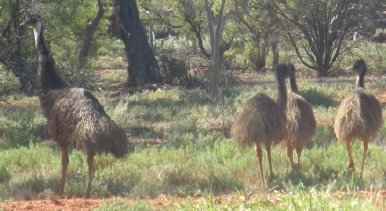
- Emu - our tallest bird, found over much of Australia except heavily settled and intensively farmed regions, most commonly seen in the outback or some coastal heath areas
- Cassowary - restricted to the rainforests of far north Queensland
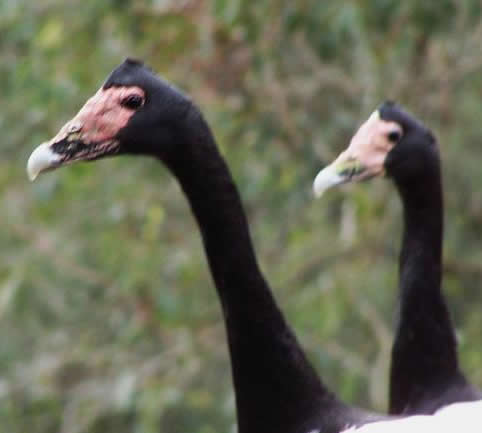
- Black-necked stork (formerly called 'jabiru' but that is more properly the name of a South American stork) - mostly a northern species, found as far south as northern New South Wales
- Magpie goose (not really a goose but in a family of its own - still related to geese and ducks
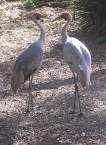
- Brolga - Australia and New Guinea, they engage in wonderful courtship displays
- Sarus crane - the world's tallest flying bird, similar to brolga, found from Australia Southeast Asia to India
- Bustard - our heaviest flying bird
- Wedge-tailed
eagle - our largest eagle, stands
about a metre tall, wingspan up to 2.5 m (8.3 ft)
- White-bellied sea eagle - almost as big and with larger talons
- Black
swan
-
- Brush turkey -
- Malleefowl -
- Lyrebird - our largest songbird, and quite a remarkable one
style="font-family: Helvetica,Arial,sans-serif;">
 Birds
with unusual
courtship or nesting behaviour
Birds
with unusual
courtship or nesting behaviour
Impressive displays
- Lyrebird
- wonderful
song and dance, and the world's best avian mimicry
- Bowerbird - 'come into my bower'
- Riflebirds -
Australia's birds
of Paradise
- Great
crested grebe - a coordinated
aquatic display
- Brolga -
wonderful prancing
dance with plenty of wing-spreading and graceful
leaps
- Musk
duck - most un-ducklike
in
appearance when it throws its head back, thrusts its
throat pouch
upwards and churns its way through the water
Unusual nests
- Megapodes
('bigfoots') Malleefowl, Brush turkey and Jungle
fowl - making sometimes
enormous mounds, eggs are incubated by the heat
released by decomposing
leaves
- Mud nesters - magpielark (NOT related to the other two, but to monarch flycatchers), apostlebird and chough (a family found only in Australia: 'chough', like so many Australian birdnames - is mis-leading, as they are not related to northern hemisphere choughs)
- Hanging nests - yellow-throated scrubwren, shining starling -
- Nests
in
termite mounds - kingfishers (including kookaburras)
- Nests
in
creekbanks and other tunnels - bee eaters, pardalote
- Many Australian birds (e.g. many parrots, some owls) nest in hollow branches or trunks of trees, and the retention of mature trees is essential for their persistence within a region.
- Cuckoos, in Australia as elsewhere, they lay their eggs in other birds' nests (but none of them say anything remotely resembling 'cuckoo')
 Birds
that landscape
our countryside
Birds
that landscape
our countryside
Many birds eat native fruits. Some crunch and digest the seeds, others just digest the soft parts of the fruit and either cough/spit out the seed or pass it through their intestines unharmed. These birds can have a profound effect on what grows where.
Some of the main dispersers in the rainforests are fruitdoves, bowerbirds, catbirds, lewin's honeyeaters, pied currawongs and cassowaries, also figbirds, which tend to visit edges of rainforests rather than penetrate deeply into them. Many others disperse seeds at least occasionally.
In more open habitats, emus, mistletoebirds, crows and many honeyeaters disperse seeds, with many other species (cuckoos, cuckooshrikes, orioles, butcherbirds, others) doing so at least occasionally.
The yellow and red pigments of the fruit is often transferred to the feathers of the bird that eats it.
Before a flowering plant (whether it's a tree, shrub, vine or herb) sets seeds, its flower must be pollinated. Many are pollinated by wind or by insects, but nectar-feeding birds such as honeyeaters and some parrots alps play an important roles. Bird-pollinated flowers tend to be fairly robust, to withstand vigorous feeding activities, and are often red, pink or creamy-white, with plenty of nectar and easily-dislodged pollen.
Birds of bright colours or 'odd' appearance
 Bright
colours:
Bright
colours:
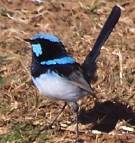
- Fairy-wrens -
beautiful little
birds found only in Australia and New Guinea (mostly
Australia) - blue,
lilac, red and other colours, not related to wrens.
Some are common
in bushland (open forest and woodland) areas
where understorey
shrubs have been retained.
- Chats
-
orange, yellow and crimson chats of the outback are
brilliant
- Pittas -
bright-coloured
birds of the rainforest floor
- Parrots - rosellas, lorikeets, others -
- Fruitdoves - pinks, greens, yellows, maroon, purple and other colours adorn these beautiful birds, but they can still be very hard to spot amongst the foliage in a rainforest.
- Rainbow bee-eaters - all the colours of the rainbow, plus two long black tail feathers that stream behind as they fly
Crested
birds:- Bazas -
these used to be
called crested hawks, which describes what they are
- Topknot
pigeon - large pigeons of the rainforest with a
'crazy hairstyle'
- Crested
and plumed pigeons - the little crested pigeons are
a familiar
sight in suburbs, rural and outback areas; plumed
pigeons live in the
outback
- Cockatoos - very well-known group of large parrots with crests of feathers on their heads. Most stunning of all is the palm cockatoo of far north Queensland forests, the largest of our cockatoos with a very impressive crest and large bill
- Crested shrike-tit
- Whipbirds
- Crested tern
- Crested
bellbird
Other unusual appearance:
- Frogmouths - these have very wide gapes and are camouflaged to like like part of the branch they are sitting on.
- Lyrebirds - as well as being the world's most accomplished mimics, the males have beautifully decorated, long tails, which they bring forward and shimmer like a small fountain during the courtship dance
 Bush
stone-curlew - the large yellow
eye is its most striking feature, and it is quite a
large bird, though
often un-noticed because of its habit of sitting or
standing very still
amongst low vegetation
Bush
stone-curlew - the large yellow
eye is its most striking feature, and it is quite a
large bird, though
often un-noticed because of its habit of sitting or
standing very still
amongst low vegetation- Avocets, spoonbills and ibises - like their relatives elsewhere, the long bill of the avocet curves upwards at its end, the spoonbill's bill splays out into a spoon shape, and the ibis has a long downwardly-curved bill.
- Emus and cassowaries - both are large flightless birds, and the cassowary also has a large casque on its head
- Channel-billed cuckoo - a large grey cuckoo with an oversize bill
- Pheasant coucal - a pheasant-like close relative of the cuckoos, which is often reluctant to fly and instead runs with head and long tail close to the ground, looking rather reptilian.
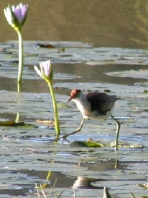
- Jacana - like the jacanas of other continents, our comb-crested jacana has extraordinarily long toes to enable it to walk on waterlily leaves
- Black swans - no longer surprising, but as in "The Black Swan: The Impact of the Highly Improbable", "In Europe all anyone had ever seen were white swans; indeed, "all swans are white" had long been used as the standard example of a scientific truth. So what was the chance of seeing a black one? Impossible to calculate, or at least they were until 1697, when explorers found Cygnus atratus in Australia".
Birds with unusual voices
- Lyrebird - a wonderful repertoire of mimicked sounds
- Catbird -sounds like a Siamese cat, or a baby crying, in northeastern rainforests, mostly calling in spring and summer
- Eastern
whipbird
- the male gives a call like a whip being twirled
through the air and
cracked. followed immediately by a 2-syllable call
of the female = one
of the most familiar calls of rainforest and
surrounding moist forest
- Crested
bellbird
- 'tip, tip, top of the wattle' - a distinctive cal
of the dry
country,with most notes high, the last dipping down
- Australian
magpie -
a lovely warbling call at dawn, and other times of
day. Our 'magpie'
is not really a magpie, not part of the crow family
at all but a member
of the woodswallow family
- Pied butcherbird - beautiful clear piping notes and complex melodies
- Laughing
kookaburra
- a famously rollicking, laughing call
- Wompoo
fruitdove
- loud "wom-poo", sometimes with variations,
penetrating the rainforest
- Pheasant coucal - loud 'whoop-whoop-whoop-whoop-whoop-whoop-whoop-"
- Common
Koel -
penetrating,
repetitive 'coo-eee' heard throughout summer in
subtropical eastern
Australia
Families
unique to
Australia or to Australia and New Guinea
Bird families unique to Australia:
- Lyrebirds
- Scrub birds
- Apostlebird
and
'chough'
(not
related
to northern hemisphere choughs - another
example of poor naming)
- Emu
- Bowerbirds
- Birds of paradise
- Magpie goose
- Cassowary
- also the subfamily magpie/currawong/butcherbird (but
woodswallows, in the same family, have spread beyond
this)
Sample of birds found from Australia to Southeast Asia and southwest Pacific only
- Honeyeaters (family Meliphagidae - not related to
sugarbirds,
honeycreepers or hummingbirds)
- Woodswallows
- Fruitdoves
Sample of birds found from Australia to Africa
- Whiteyes
- Pittas
- Rollers
- Bee-eaters
- Swamp-hens
-
occasionally
appear
also
on the Mediterranean shores of Europe
Threatened species
Eastern bristebird. There was a very successful captive breeding program happening at the David Fleay WIldlife Park, starting from the only two they could find after extensive searching - a brother and sister pair. Unfortunately this breeding program has now been abandoned.Coxen's figparrot. This small parrot used to depend on the abundance of fruiting figs in lowland rainforests during the winter months. Now most of the lowland rainforest has been cleared, and the Coxen's figparrot (a subspecies of the double-eyed parrot) is now rarely seen and probably only a few dozen individuals remain, if that.
Cassowary. In patches of rainforest remnants that have lost the cassowary, there is a severe reduction in seed dispersal of plants with large fruits, although fruitbats, rodents or the musky rat kangaroo may carry some of them a short distance .
Many others - see Birds Australia's Threatened Bird network and the Australian government's list of threatened bird species
The flightless ones - emus and cassowaries
The rattites are a group of large flightless birds now found only in the southern hemisphere, including the rhea of South America, ostrich of Africa, emu of Australia and cassowaries of Australia and New Guinea.Emu
Australia's largest bird.
There used to be two other species on southern islands, but they were driven to extinction by hunting.
Cassowary
A very important seed disperser in northern rainforests, as there are many large fruits impossible for anything else to swallow.
 Waterbirds
- black
swans, ducks, storks, cranes, waders, gallinules and
others
Waterbirds
- black
swans, ducks, storks, cranes, waders, gallinules and
others
- Ducks, swans and geese
- Magpie geese - these appear to have diverged from the ducks, swans and geese in the Cretaceous. It is sufficiently similar in bill structure to these to be placed in the same order, but sufficiently different to be given a family all to itself. It is found in northern Australia and southern New Guinea
- Waders
-
many species
- Herons, ibises, egrets and spoonbills
- Storks
-
one species in Australia (the black-necked stork,
formerly known as
jabiru)
- Cranes,
crakes, rails and bustards (not all of these stay
near water)
Marine birds
- Waders - there are many species of wader in Australia, and while some are quite distinctive, many others look very similar to one another, so it can take a fair bit of practice to get accustomed to identifying them. See Australasian Waders Study Group
- Gulls
and
terns - the familiar seagulls on most of our beaches
are the silver
gull, but there are several other species of gulls
and terns
- Pelicans,
darters and cormorants Australia has one
species of pelican, one
anhinga (darter) and several cormorants, which can
be found anywhere
from the sea to inland lakes
- Boobies
and gannets - several species
- Albatrosses
-
several
species
in
southern oceans
- Sea eagles, brahminy kite and osprey
- reef herons and relatives
- Birds
of
the mangroves - mangrove kingfisher, stone-curlews,
ibis and various
other birds can be seen in the mangroves, especially
when the tide is
on its way out and crabs are active
Migrants and nomads
- Honeyeaters - some are regular migrants, others are nomads following nectar abundance
- Silvereye - some of these tine birds are known to make impressively long flights
- Mistletoebird - follows the fruiting of mistletoes
- Cuckoos - some, such as channel-billed cuckoos and koels, breed in Australia's subtropics and go back north for winter
- Dollarbird - another bird (in the same family as the rollers of Africa and Asia, related to kingfishers) that breeds in subtropical Australia and heads back to far north Australia, New Guinea or southeast Asia for the winter
- Ducks and other nomadic waterbirds - many Australian species are adapted to wandering in search of water when inland lakes and watercourses dry up
- Pelicans
and cormorants - as for ducks
- Waders
-
many waders migrate, some flying regularly between
Asia and Australia.
See the Australasian
Waders Study
Group for more information
- Terns
-
the Arctic tern is the longest traveling of all
animals, and also sees
more sun than any other species. It travels between
Arctic summers and
Antarctic summers, mostly down the coast of South
America or Africa but
occasionally appearing briefly in Australia
and regularly on
SubAntarctoc Islands to the south.
- Penguins - the only birds that migrate by swimming (not so much migration in Australian waters as in South America and Antarctica). Little (or 'fairy') penguins, the only species to breed on the Australian continent, do sometimes take long trips out to sea, returning to their nesting areas now and then even when not breeding
- various
others ...
 Cockatoos
and parrots
Cockatoos
and parrots
Cockatoos
Cockatoos are essentially parrots with crests (and gall bladders)
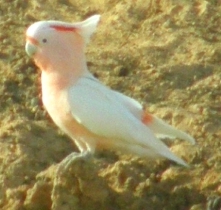
Most of the world's cockatoos are Australian, with a few species in New Guinea and southeast Asian islands. They all have crests, ranging from the small crests of cockateils, galahs and corellas to the spectacular ones of major mitchells and palm cockatoos.
Wikipedia has a good cockatoo page
Rosellas
Rosellas are a purely Australian group of colourful parrots with long tails and a pattern of little black scallops on their backs.
Lorikeets
These bright green or multi-coloured little parrots feed mostly on nectar and pollen
Budgerigars
One of the world's most popular pet birds, they still live and breed in in large flocks in Australia's outback
Other parrots
There are many pother parrots in Australia, from the small and critically-endangered Coxen's figparrot to the large and colurful king parrots.
Cuckoos - none say 'cuckoo' but they do lay eggs in other birds' nest (except one)
The exception to the rule of laying eggs in other birds' nests is not actually a cuckoo, it is a coucal, but very closely related. There are several coucal species in Southeast Asia, and we have one, the pheasant coucal, so-called because its shape resemble a pheasant. It also looks rather reptilian as it runs along, head and long tail close to the ground, before taking off in a clumsy flight.
None of our cuckoos say anything remotely resembling "cuckoo." One gives a loud prolonged squawk (channel-billed cuckoo), one a kind of 'cooee' call (koel), one a downwards trill (fantailed cuckoo), another a series of rather frantic calls as though the bird is heading for a nervous breakdown (brush cuckoo), and others give various kinds of whistling calls. The only bird that actually sounds like a European cuckoo is an owl, the boobook owl.
Different sizes of cuckoo naturally choose nests of different sized birds to lay their eggs in. The big channel-billed cuckoo for instance lays its eggs in the nests of crows and similar-sized birds, while small cuckoos lay in the nests of small birds: the young cuckoo may still be quite a lot larger than the nestlings of the host bird.
Megapodes - males build large mounds in which the eggs are incubated
This is a family of large-footed birds from Australia to Southeast Asia. The three Australian species, as do most megapodes, hatch their eggs by the heat of decaying vegetation (there is at least one species in Asia which instead uses the heat of active volcanoes).
Probably the best-known megapode in Australia is the brush turkey, easily seen in rainforest areas and sometimes entering the suburbs of Brisbane (not always welcomed by home-owners, who may for instance find all the pine chips from their garden scratched into a mound against their garage door)
Find information here on the malleefowl, of dry open country in southern Australia (the world's only megapode to NOT live in dense forest)
The smallest species in Australia, the orange-footed scrubfowl, builds an impressive mound up to several metres in diameter.
You can see a list of the world's megapodes, with links to photos, videos and calls, here.
See also a good book on the megapodes by Darryl Jones, who studied the brush turkeys some years ago for his PhD, and two co-authors.
Pigeons
-
bright-coloured fruit-eaters, many seed-eaters
Fruitdoves and topknot pigeons (not to be confused with crested pigeons) eat fruit, digesting the softer parts and either regurgitating the seeds or passing them through their intestines before discarding them, and thus are important seed dispersers for many rainforest trees. They live in coastal regions of northern and eastern Australia (south as far as northern New South Wales) and also in New Guinea and Southeast Asia.
style="font-family: Helvetica,Arial,sans-serif;">Most pigeons, like pigeons the world over, digest the seeds they swallow. One of the best--known is the crested pigeon, fund in most open habitats over much of Australia.
Pictured here are the wonga pigeon (left) and the wompoo fruitdove (right)
Birds of prey - day and night
Diurnal raptors (eagles, hawks, falcons etc.)
There are 24 species in Australia
Eagles include the wedge-tailed eagle (largest species), white-bellied sea-eagle and little eagle
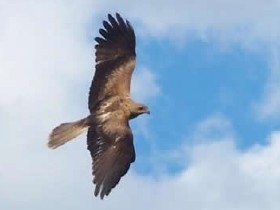
Kites include the brahminy (beautiful white and red-brown plumage, hunts fish along coasts), whistling (big enough and similar enough wing pattern to be mistaken for little eagle, but with distinctive call), black (very common in outback), black-winged (often seen hovering), letter-winged (often hunts at night, although technically one of the diurnal raptors),
Others include black-breasted buzzard (which is not actually a buzzard), osprey (same species as in northern hemisphere), several goshawks, two harriers, a sparrowhawk, a baza, several falcons (including the Peregrine falcon found also in other continents) and a kestrel (essentially a small falcon, but kestrels hover more than other falcons).
Owls
There are 10 species in Australia
Boobook - an owl whose call is often mistaken for something else. The boobook owl gives the 'mopoke' call, one of the most familiar sounds of the Australian bush at night (and the closest sound to a European cuckoo call that you will hear in Australia). Many people are convinced it is the tawny frogmouth, but this is incorrect. The boobook is often heard but not seen, while the frogmouth is often seen and not heard, in the same patch of forest. Others in the past have insisted the 'mopoke' call comes from the echidna, the goanna, or even the carpet snake, presumably because they have gone outside to investigate the source of the call, found one of these creatures and not seen the mottled brown owl sitting quietly on a branch close to the trunk of a tree.
Powerful owl - our largest owl, with a wingspan of about 1.3metres, and feeds mainly on arboreal mammals and roosting birds.
Barking owl - it usually sounds like a small dog barking, but every now and then gives a blood-curdling scream which has earned it the nickname of 'mad woman owl.' I'm told that if you hear in in the middle of the night while camping it makes all the hairs on the back of your neck stand up.
There are various other owls, including the barn owl (Tyto alba) which is found throughout Australia, and on all continents except Antarctica, and some rarer relatives, such as two species of sooty owl (their calls at night sound a bit like a bomb falling but never landing).
Nightjars and frogmouths
Frogmouths are sometimes mistaken for owls. They do hunt at night, as do other nightjars, but by a different method (sitting and waiting, then pouncing on prey, which they swallow whole with their enormously-wide bills, instead of tearing it apart the way owls do, and their feet are considerably weaker than those of owls for this reason). Their nearest relatives apart from the nightjars (Australia has several species, including the cute little owlet nightjars that look like something created by Disney) are the oilbirds and potoos of South America.
Tawny frogmouths (the common species, found throughout most of Australia) definitely do NOT, EVER make a 'mopoke' call, despite Banjo Patterson's poem and the adamant protests of many who still believe they do. They instead makes a repetitive call - 'oom-oom-oom' which in its most rapid form sounds like some kind of machinery starting up, plus a few low 'growling' noises.
During the day, frogmouths sit on a branch at an angle, and are perfectly camouflaged to blend in and look like a short projection of broken branch. It is easy to walk right past one without noticing it.
Kookaburras and
other
kingfishers
If a name for the family was to be selected in Australia, they would probably nit have been called kingfishers, as only a few of our species actually fish, most catch small lizards, large insects and the like. The largest members of the family - the kookaburras, also catch snakes.
The best-known species is the laughing kookaburra, with its rollicking laughter. The other is the blue-winged kookaburra of the northern half of Australia, which has a strange call sounding like it's trying to laugh and not quite getting it right. Both species have blue on their wings, but the blue-winged kookaburra has the largest patch.
The beautiful little azure kingfisher, with bright blue above and bright red on the breast, does feed on fish, and sometimes follows the platypus in the hope that it will disturb fish that it can then more readily detect and catch.
Songbirds - evidence for an Australian ancestry
The oldest known songbird (passerine - order Passeriformes) fossils are from Murgon, in Queensland Australia, and the primitive features in some of our birds (e.g. lyrebirds and scrub birds, as well as New Zealand fern wrens) suggest an Australian origin for this, the largest order of birds. Visit this site for a good summary of current thinking on the evolution of songbirds
Lyrebirds - world's best mimics (and great dancers too)
The lyrebirds were until recently placed in the suboscines, but DNA research suggests otherwise
Strange that a suboscine would be such an accomplished songster.
There are only two species in the world, both confined to Australia - the superb lyrebird of eastern forests (to as far north as southern Queensland) and the Albert's lyrebird (subtropical forests of Qld/NSW border regions)
David Attenborough's 'Life of Birds' shows a lyrebird mimicking the sounds of camera shutter releases and motor drives
You can also hear lyrebirds and read about one research program here
Scrub birds
Small, brown secretive birds of dense vegetation (therefore not easy to see, and also not at all common, but they have penetrating calls). A family confined to Australia, and with primitive characteristics, they appear to be most closely related to lyrebirds, and despite not having the size or elaborate tail feathers, the males also court the females with song, dance and mimicry.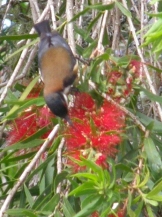 Honeyeaters - the
largest songbird family in Australia, many and varied
species
Honeyeaters - the
largest songbird family in Australia, many and varied
species
You can hardly go walking anywhere in Australian forests, woodlands or heathands without seeing or hearing some kind of honeyeater.
They do not eat only nectar - all eat insects as well for protein, and some also eat fruits. Those that include the larger proportions of nectar in their diets tend to have longer bills than those with a higher proportion of insects in their diets. Many are important pollinators of plants, especially in the Myrtaceae (eucalypts, bottlebrushes), Proteaceae (banksias, grevilleas) and Epacridaceae (heathy shrubs) families. Many also eat small fruits and can be important seed dispersers. Many are nomadic, some make fairly regular migrations, some are residential throughout the year. Some prefer to forage in the canopy, others close to ground level or even on the ground.
They are a primarily Australian and New Guinea family of songbirds (Meliphagidae, which means honey-eating), but extending out into the extreme southeast of Indonesia and some southwest Pacific Islands.
[They are NOT related to hummingbirds, honey-creepers, sugarbirds or sunbirds, although bearing some resemblance in appearance and behaviour. Australia has one species of sunbird in the tropical north, none of the other groups just mentioned)]
This page gives a list of all honeyeaters, with links to other facts, photos and videos
Australian 'magpies' and their relatives
Early settlers in Australia saw big black and white songbirds, called them magpies and the name stuck. They are a totally different bird from the magpies of the Northern Hemisphere, belonging to a totally different family, but it looks as though the name 'Australian magpie' is here to stay. Their early morning warbling is familiar to almost everyone who has spent any time in Australia. Their habit of diving on passers-by in spring is not so endearing, but it is only a few individuals that become this aggressive when defending their nests, and it is almost always in cities and towns. They are found only in Australia and New Guinea
Currawongs (Australia only) and butcherbirds (Australia and New Guinea) are closely related to Australian magpies.
The pied currawong eats a lot of fruit as well as insects and small invertebrates, and its habit of frequenting both rainforests and open country makes it a potentially important seed disperser in forest restoration areas. It unfortunately also eats nestlings of smaller birds, which is part of natural ecological processes, but where they have been artificially fed and increased their populations this can be a real threat to other birds.
Butcherbirds derive their name from their habit of hanging their prey from forked twigs (not impaling them a a Northern Hemisphere shrike does). There have been some interesting studies and speculations on the beautiful and complex calls of the pied butcherbird.
The above birds used to have a family of their own, but DNA analysis has shown them to be so closely related to the woodswallows (which are not swallows - just look and act a bit like them) that they are now all included in the same family (Artamidae). The woodswallows occupy some of Southeast Asia and Southwest Pacific islands as well as Australia and New Guinea.
The magpielark and monarchs - who would think they are related?
The magpielark is found throughout Australia in just about every kind of habitat except dense forest and the driest deserts. It builds a mud nest and does much of its foraging on the ground.Monarch flycatchers are considerably smaller than magpielarks, forage mainly amongst the foliage of trees, and in Australia at least are generally forest-dwellers, including dense rainforests, and do not build mud nests. They are considerably smaller than magpielarks, and at first sight bear little resemblance to them.
The magpielark was one lumped in with the apostlebird and white-winged chough in Australian bird books because all build mud nests, but it was soon apparent there was little other similarity, and the magpielarks were given their own family, the Grallidae. More recently, DNA testing has shown their closest relatives are the monarch flycatchers (Monarchidae).
There are two species of magpie lark - one in Australia (formerly called mudlark, also variously known as 'peewee', 'Murray magpie" and various other colloquial names) and one in New Guinea. Monarch flycatchers are found from Africa (including the paradise flycatchers) through Asia to Australia and some Pacific islands.
 Apostlebirds
and
choughs - endemic mud nest builders
Apostlebirds
and
choughs - endemic mud nest builders
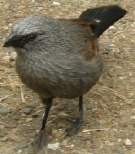
This is a small family - only two species - both found only in Australia
They are unusual amongst songbirds in building mud nests.
Both tend to move around in small flocks (apostlebirds often about a dozen - hence the name, choughs about half that) along the ground or low in trees and shrubs in the open woodlands of rural and outback Australia
The white-winged chough is not an actual chough (which are in the crow family) - just another example of Australian birds being called after something they reminded someone of.
Fairy wrens
- small flashes of colour in the bush
Not related to actual wrens, this is a group of dainty and colourful small birds with long, upright tails. Anywhere in Australia there will be one or more species, as long as the low vegetation they depend on remains.
In common with a number of other Australian birds, individuals other than the parents help feed young in the nest.
Females do an extraordinary 'rodent-run' to draw predators away from the nest, with head and tail down and feathers fluffed out to look like a small fluffy mammal.
Shrike-thrushes and whistlers - songsters bright and drab
Shrike-thrushes are not thrushes but share a family with the whistlers. The calls of this family are amongst the most pleasing of forest bidcalls in Australia, and while some are dull browns and greys, others - like the golden whistler - look as pretty as they sound. They are primarily insect-eaters.
 The
'robins' -
red-breasted, yellow-breasted and plain (none are
actually robins)
The
'robins' -
red-breasted, yellow-breasted and plain (none are
actually robins)
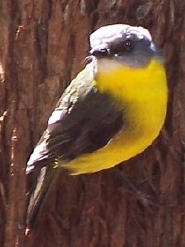
The early settlers, probably homesick for the English countryside, saw red-breasted birds and called them robins. These birds are not in the thrush family (as true robins are) but belong instead to a family (Petroicidae) ranging from India to New Zealand.There are a number with pink or red breasts (pink robin, rose robin, flame robin, scarlet robin, red-capped robin), others with yellow breasts (eastern yellow robin, western yellow robin, pale yellow robin) and others with no bright colours.
They are primarily insect-eaters.
Most are forest or woodland dwellers, but scrub-robins live in drier, more open habitats of the inland.
 Bowerbirds -
incredible artists of the bird world
Bowerbirds -
incredible artists of the bird world
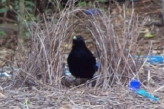
I have watched a satin bowerbird building tis bower - putting a twig in place then standing back surveying it as a human artist might, deciding it didn't look quite right, picking it up again and repositioning it until it was satisfied.
The males of all bowerbirds build some kind of display ranging from leaves on the ground to elaborately-decorated avenues of twigs or other complex structures. It takes about 6 or 7 years before a young male starts to build bowers, and can take another 1 or 2 before he can do it well enough to start attracting females. It seems females may vary in what attracts them. After mating, the female heads off to build a nest and raise chicks on her own while the male continues his attempts to attract other females.
See a David Attenborough video of a bowerbird and bower
Birds of Paradise - most are in New Guinea, but Australia has four species
Most birds of this family live in New Guinea, but three species live in the far northern tropical rainforests (Victoria's riflebird, magnificent riflebird and manucode) and one species (the paradise riflebird), the only non-tropical member of the family, inhabits subtropical rainforests of southeastern Queensland and northeastern New South Wales. The Australian species do not have the brilliant colours and long tail feathers the family is best known for, but the males are shining black with iridescent purples, blues and greens. Like their relatives, they display during courtship - the manucode spreading its wings and trumpeting, and the riflebirds lifting their wings, throwing back their heads and rocking side-to-side.
style="font-family: Helvetica,Arial,sans-serif;">
And the rest ....
Buttonquails - small, three-toed, seed-eating birds that are not quails, although they look a bit like them, found from Africa and southern Europe through to Australia. Some turn the tables on a more usual male habit, courting a male then leaving him to look after the eggs and chicks while she seeks her next partner.
Pittas - bright -coloured birch of the rainforest floor - use stones for cracking snail shells, found from Africa to Australia
Pardalotes - pretty little birds usually high in the treetops, more often heard than seen, but often come down in spring to tunnel nests into creekbanks
...many others!
style="font-family: Helvetica,Arial,sans-serif;">
Links to books and further information
Some very useful field guides to birds of Australia:- Morcomb, M. 2002. The Michael Morcomb Field Guide to Australian Birds
- Morcomb,
M. 1988. The Great Australian Bird Finder: Where
& How to Find
Australian Birds.
- Pizzey, G. and Knight, F. (1997). Field Guide to the Birds of Australia. Angus and Robertson, Sydney
- Reader’s Digest (1997). Encyclopaedia of Australian Wildlife. Reader’s Digest, Sydney (it can’t include all species the way the more specialized books do, but does give a good coverage of mammals, birds, reptiles, frogs, freshwater and marine fish, and some invertebrates)
- Reader’s Digest (1990). Reader’s Digest Book of the Great Barrier Reef. Reader’s Digest Services, Sydney.
- Simpson, K, and Day, N. (1996), Field Guide to the Birds of Australia. Viking Publishers, Ringwood
- Slater, P. , Slater, P. and Slater, R. (1989). The Slater Field Guide to Australian Birds. Landsdowne Publishers, The Rocks, Sydney
Websites with a wealth of information on Australian birds:
- Birding
discussion group - birdingaus
- Birding
Observation and
Conservation Australia (BOCA)
- Australian Museum
- Birds Australia
- Australian Bird Study Association
- Birdwatching
Australia
International sites:
Also see WIldlife of the Scenic Rim and WIldlife seen on our tours